Diese Webseite verwendet Cookies, um externe Inhalte anzuzeigen und um anonymisierte Statistiken über das Nutzungsverhalten zu erfassen.
+ – ars viva 2026
Prateek Vijan u. a.
Freitag 13.03.26
Eröffnung
19:00 Uhr
Prateek Vijan u. a.
19:00 Uhr
Despina Pagiota, Luisa Telles, Luzia Cruz u.a.
19:00 Uhr
Philine Mayr
In der Annahme, dass Sehen ein aktiver Akt ist, beschreibt Pythagoras mit dem „Sehstrahl“ in der griechischen Antike das Auge als Sender, dessen Vektoren die Wirklichkeit abtasten. Sehen ist für ihn eine produzierende Praxis. Die Ausstellung Introducing: The Crumb von Philine Mayr verschiebt diesen Gedanken in einen zeitgenössischen Bildkontext. Sie verhandelt die These, dass Sehen sowohl Erfassen von Welt als auch deren Hervorbringung ist. Damit verändert sich auch der Begriff von Perspektive als Ordnung eines äußeren Raums hin zu einer Projektion aus dem Inneren der Sehenden.
Die künstlerische Praxis von Mayr tastet die Bedingungen der Bildentstehung ab und untersucht, welche ästhetischen Entscheidungen Bilder hervorbringen und wie formale Kriterien deren Wahrnehmung bestimmen. Ihre Arbeiten beruhen auf der malerischen Auseinandersetzung mit einem wachsenden fotografischen Archiv. Oft sind es konkrete Bildausschnitte, denen sie sich in einer Mischung aus konzeptionell strukturiertem und „sehendem“ Vorgehen nähert. Im Fokus steht dabei die Untersuchung, wie Licht die Konstruktion und Wahrnehmung von (räumlicher) Sichtbarkeit und Körperlichkeit strukturiert.
In Introducing: The Crumb geht Mayr von einer spekulativen Setzung aus: Von einem festgelegten, unzugänglichen Punkt inmitten einer Säule an der äußeren Ecke des Ausstellungsraums erscheint das Auge als Projektionsapparat, vergleichbar mit einem Beamer, von dem aus sich Bilder in den Raum einschreiben. Die zentrale Arbeit, The Crumb (2026), erscheint so als Projektion eines inneren Bildes. Mayr denkt die physische Leinwand als durchlässige Bildoberfläche, hinter der sich die Bildinhalte verzerrt, verschoben und perspektivisch gebrochen an den Wänden des Raums fortsetzen.
Die Ausstellung verhandelt neben dem Verhältnis von Produktion, Rezeption und Illusion auch die Übersetzung zwischen Analogem und Digitalem, die unter anderem im 16:9-Format der Leinwand sichtbar wird. Angetrieben von einer auf einen Bildkern gerichteten Suchbewegung zerlegt Mayr die zentrale Arbeit der Ausstellung in ihre Bestandteile: Fläche, Farbe, Motiv. Die Wandmalereien gehen aus einer aktiven Reduktion hervor, in der Farbe reduziert und Plastizität zurückgenommen wird. Wenn das Auge als projizierend gedacht wird, lassen sie sich auch als Rückstände innerer Bilder lesen. Sie sind Fragmente dessen, was aus dem Inneren nach außen projiziert wird, ohne jemals vollständig zur Deckung zu kommen.
Philine Mayr, Introducing: The Crumb
18:00 Uhr
Philine Mayr
moderiert von Anna Bochkova
Kastania Waldmüller, Adrien Lagrange, Sudabe Yunesi
19:00 Uhr
Jaewon Kim u.a.
19:00 Uhr
19:00 Uhr
Eda Aslan a.o.
15:50 Uhr
„Art Girls“, ein Film von Robert Bramkamp mit Kunst von Susanne Weirich, Produktion BramkampWeirich GbR, International Film Friends Hamburg, D 2014, 120 Min.
Im Rahmen von „Metabolism: Inorganic Evolution“, kuratiert von Zhichao Zhu
Inae Shin, Qiannan Zheng, Wei Zhu
19:00 Uhr
Screening von „Die Ausstattung der Welt“ / „Make Up the World“ (Buch, Regie, Produktion: Susanne Weirich, Robert Bramkamp, D 2023, 99 Min).
Kuratorenstatement:
Metabolism: Inorganic Evolution
—Robert Bramkamp & Susanne Weirich: Film Showcase and Workshops
Before entering the horizon of artistic practice, objects or props often remain dormant at the dead-ends of functionality or within the redundancies of global supply chains—static entities in a state of „suspended animation“ under standardized production. However, in the intertwined practices of Robert Bramkamp and Susanne Weirich, these inorganic bodies are stripped from their mundane routines and transformed into active existences that bridge the boundaries between the material and the biological, fact and fiction. In this context, objects are no longer cold residues of history, but „live participants“ undergoing continuous metabolism, self-proliferation, and narrative evolution.
This metamorphosis stems from the deep convergence of two distinct creative logics: Weirich utilizes spatial installations to deconstruct the social coding of matter, employing serial expansion and the fragile transformation of materials to evoke a sense of ritual released during the „disappearance“ of physical form—hinting at the displacement of life and the projection of spirit. Meanwhile, Bramkamp penetrates the surface of the object through a „Docu-fiction“ cinematic engine, implanting fictional evolutionary genes. By using moving image interventions to blur the threshold between the documentary and the fabricated, he endows standardized industrial products with subjective desire and narrative momentum.
This represents a complementary evolutionary path for the „Object“: Bramkamp drives the
evolutionary soul of the narrative, while Weirich shapes the tactile body of matter. Through film screenings, dialogues, and workshop practices, we will witness how objects transfigure from standardized dead matter on an assembly line into narrative with emotional tension and historical depth. Here, the evolution of the inorganic is no longer a physical accident, but a vitalistic metabolism driven by artistic will, a moving-image experiment on the reconstruction of reality.
Text by Zhichao Zhu
mit Martin Boyce
Bitte vorab bei Martin Boyce anmelden, Treffen findet online statt. Link wird bei Anmeldung bekannt gegeben.
Jorinde Voigt u.a.
Chinesische Premiere von „Die Ausstattung der Welt“ (Buch, Regie, Produktion: Susanne Weirich, Robert Bramkamp, D 2023, 99 Min)
Q&A mit Dr. Evelyn Hust (Goethe Institut), Susanne Weirich, Robert Bramkamp
Eine Veranstaltung in der Reihe „Metabolism, Inorganic Evolution“, kuratiert von Dr. Zichao Zhu
Harriet Foster, Bruno Kühn
Chinesische Premiere von „Gelbe Sorte“ (Buch&Regie: Robert Bramkamp, Filmwerkstatt Münster, D 1987, 90 Min) sowie Gespräch Dr. Zhichao Zhu, Robert Bramkamp
Eine Veranstaltung in der Reihe „Metabolism, Inorganic Evolution“, kuratiert von Dr. Zichao Zhu
Omid Arabbay, Ayala Berger, Leonidas Kosmidis u.a
19:00 Uhr
Rosanna Graf, Fion Pellacini u. a.
Eröffnung: 14. Februar, 18 Uhr
Evo Sidney, Talia Kurman, Lia Stürze, Maren Stocklöw, Linus Berg, Maria Martha Szymkowiak, Nick Wachs u.a.
19:00 Uhr
Niclas Riepshoff u. a.
19:00 Uhr
Noémi Barbaglia
16:00 Uhr
14:00 Uhr
Ula Ahmed u.a.
16:00 Uhr
Oksana Yushko
20:00 Uhr
Anna Stüdeli
18:00 Uhr
Felix Egle, Daniel Hopp u.a.
The Chinese Film Festival Hamburg (CFFH) returns for its 4th edition, continuing its „Film Plus“ mission to bridge Sinophone cinema with contemporary art. Founded in 2022 by Hanqi Sheng and Zhichao Zhu, this year’s festival centers on the theme „Ever Becoming | 未竟之境,“ exploring the moving image as a state of continuous emergence. The event will be officially inaugurated with greetings from Prof. Robert Bramkamp and Prof. Ruby Chen.
The festival will take place at Metropolis, Lichtmeß & more venues across Hamburg.
19:00 Uhr
Johannes Büttner u. a.
Bianca Itte, Peter Lampe, Emilia Storgaard u.a.
17:00 Uhr
Academic Seminar: 3–5:30 p.m.
as part of the 4th Chinese Film Festival Hamburg
curated by Zhichao Zhu
19:00 Uhr
Lennart Münchenhagen, Anna Steinert u.a.
Filipe Lippe u.a.
19:00 Uhr
Karla Zipfel, Paula Erstmann u. a.
18:00 Uhr
Julia Tielke, Clara Umbach
Film Screening und Lesung
mehr Infos
Workshop organisiert von Eva Horn (HIAS/Universität Wien) and Maximilian Hepach (Durham University)
Anmeldung unter event@hias-hamburg.de
Elisa Juri
Filmscreening und Lesung mit Elisa Juri
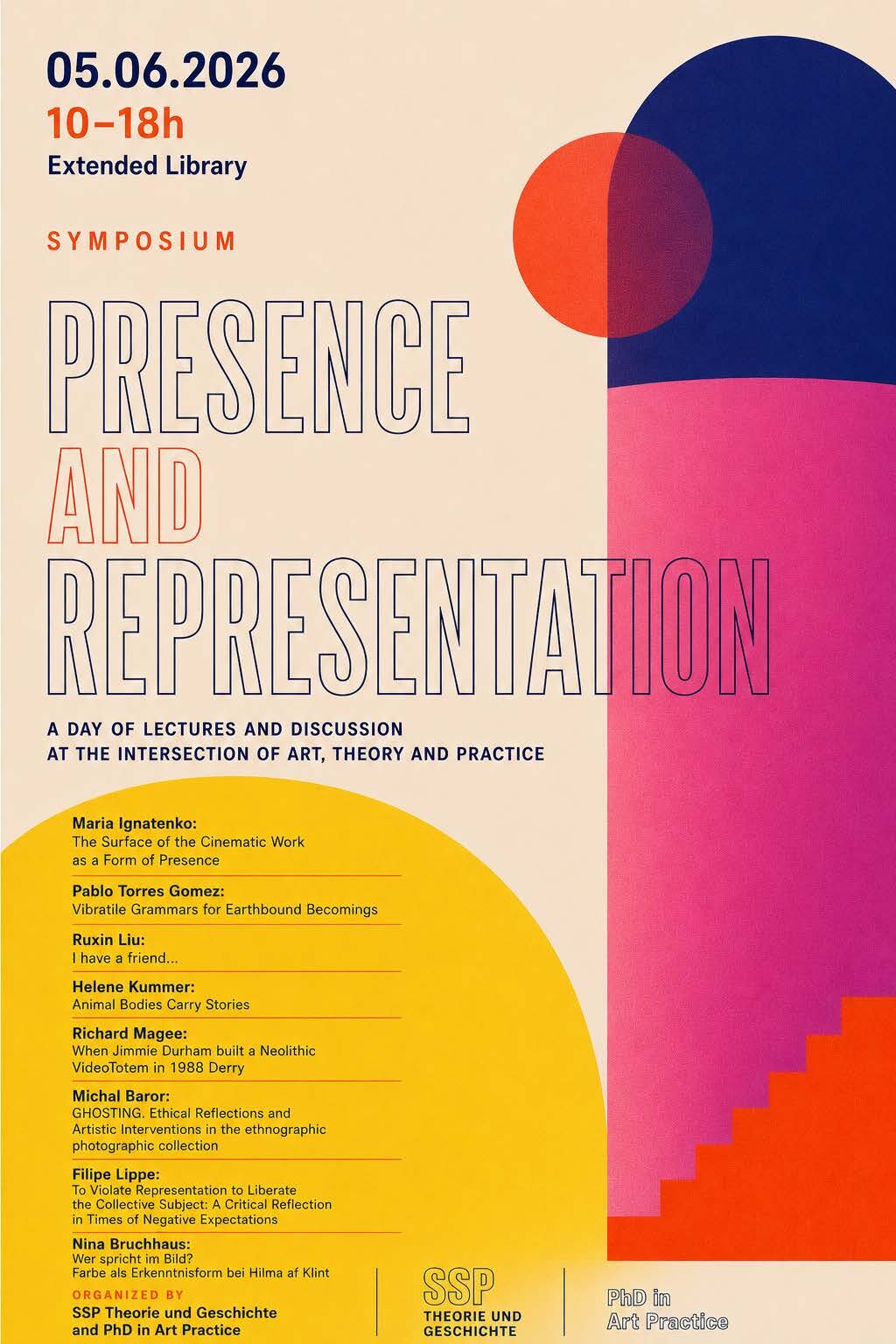
Helene Kummer, Sara Hillnhütter, Jessica Ullrich, Terue Yamauchi, Bettina Uppenkamp, Antonia Ulrich
What does it take to shift from learning about the living world to learning from and with the living world?
The symposium invites us to consider artistic research as a relational practice of storytelling. Getting involved with the lives and stories of animals, trees, or the sea changes the temporalities and modes of research and art practice. Which active forms of engagement can open up spaces for mutual learning? What kinds of relationships emerge through accompanying and listening? Which stories do these relationships hold, and how can they be told?
Taking up ecologist Gary Nabhan’s reflection : „The restoration we need to do is also a re-story-ation“ — the event gathers different perspectives and approaches that seek to tell more than only human stories. Together with the guests and participants we also want to discuss questions of responsibility and limits: How can these relationships become reciprocal? How to deal with the tension between relation and representation?
The PhD program „being(s)“ invites to this one day event with Talks, a Film Screening and a performative walk.
Open for everyone, No registration needed.
Language: English
10:00–11:00
being(s) : More-Than-Human Drama
Introduction to the symposium and the research project ‚More-Than-Human Drama‘ as part of the being(s) graduate school at HFBK.
In her artistic research, Helene Kummer examines the dramaturgical, linguistic, and aesthetic articulations of so-called „animals“ in storytelling – particularly in animation -and how these representations shape human-animal relationships. Scratch marks from raccoons on the wooden structures of Japanese temples hold a multitude of stories and relationships. They are the traces of a popular animation production from the 1970s that influenced ways of seeing and treating these animals, which are considered invasive. Together with Terue Yamauchi, the two artists collect documents, stories, and relationships connected to these contexts and are developing a feature film.
Helene Kummer – PhD Candidate Art in Practice, HFBK
Sara Hillhütter – Officer for Artistic Practice, HFBK
11:00–12:00
Shared Worlds: Imagining Multispecies Futures
Shared Worlds explores how contemporary art functions as an experimental space for imagining and testing utopian futures beyond anthropocentrism. Art is framed as a speculative practice that challenges the status quo and anticipates alternative forms of coexistence with nonhuman animals. Through historical and contemporary case studies the lecture examines how art envisions, rehearses, and sometimes realizes multispecies communities. Central to the discussion are questions of animal personhood, agency, radical hospitality, and feminist ethics of care. The talk proposes an expanded concept of art that takes nonhuman aesthetic practices seriously and recognizes animals as collaborators and co-creators of worlds.
Prof. Jessica Ullrich - Kunstakademie Münster, Editor of ‚Tierstudien‘ Publication
12:00–13:00
Ancestral Sea: Where Lives and Memories Reside
„Crossing Tides“ (2018) emerged from a decade-long relationship with an elderly woman—the last remaining ama (sea women / female free diver) on an island between Japan and the Korean Peninsula, who embodied a life deeply attuned to the sea and its tides. In this talk, I will share a selection of key excerpts from the film and reflect on the process of its making, discussing how I came to understand that relationships—and their storytelling—are not something we can simply „make“ or „develop,“ but rather something that emerges organically over time through ongoing negotiation with constantly shifting, living elements, including the artist, participants, the environment, the weather, and all that it shapes.
Terue Yamauchi – Artist and Film Maker, Fukuoka (JP)
14:00–15:00
The Earth under Water: Images of the Great Flood and Noah’s Ark in Medieval and Early Modern Art
Narratives of a life-destroying great flood belong to the mythological heritage of numerous cultures. This catastrophe is generally understood as a form of divine punishment for human guilt and sin. In the Old Testament, Noah, as the only righteous man, is instructed to build an ark and to save not only his family but also a pair of every kind of animal—both pure and unpure—“birds and livestock and every creeping thing“ (Gen 8:17), in order to repopulate the earth after the flood. This lecture focuses on images from earlier periods of art history and, in particular, asks which species were deemed worthy of representation.
Prof. Bettina Uppenkamp – HFBK Hamburg
15:00–16:00
Perceiving Encounters: Kuhmühlenteich
Close to the HFBK Hamburg, at the intersection of city and river, lies a place of relations: the „Kuhmühlenteich“. This short, theoretically and sensually engaged walk is an invitation to perceive the living world at this specific place. The journey begins with a brief input that informs about the site’s layered history. It is followed by a ‚Reading Walk‘ in which participants read short texts and discuss them with respect to the environment.
Antonia Ulrich - Institute for Arborphilia, Animals, Aesthetics and Activism (Hamburg)
Mit Blick auf 60 Jahre Film an der HFBK Hamburg untersuchte das Film-Symposium Cine*Ami*es im vergangenen Jahr Freundschaft als kritische filmische Praxis und fragte, wie ästhetische Unabhängigkeit durch Formen der Verbundenheit zwischen Menschen, Techniken und Umgebungen aufrechterhalten wird.
Ein Jahr später öffnet Cine*Ami*es diesen Horizont in Zusammenarbeit mit dem Chinese Film Festival für Xin Zhus All Quiet at Sunrise. Die experimentelle Form des Films bringt Sprache, Verwandtschaft, Erinnerung und Begehren in ein gemeinsames Feld. Im Rahmen von Cine*Ami*es erscheint All Quiet at Sunrise als ein Werk, das der Beziehung eine präzise filmische Textur verleiht. Denken, Intimität und Weitergabe entfalten sich gemeinsam. Die Vorführung lenkt die Aufmerksamkeit auf das Kino als eine Praxis, durch die fragile Formen der Verbindung sichtbar, hörbar und teilbar werden.
Im Anschluss an das Filmscreening laden wir zum Roundtable-Gespräch zwischen Xin Zhu, Robert Bramkamp und Elisa Linseisen, moderiert von Ruby Chen.
Xin Zhu, All Quiet at Sunrise, 2025; Filmstill
mit Abel Auer
Milan Skrobanek
Filmvorführung & Gespräch mit Regisseur Milan Skrobanek
Charlotte Perka u.a. auf Montage
Harry Thring u.a.
19:00 Uhr
Harry Thring u.a.
19:00 Uhr
Künstler*innen: Ki Bui, Trieu Dao, Sina Eichhorst, Luzie Ana Catalina Katzorke, Willi Mend, Emiliano Mondragón, Josie Overton, Sude Nur Tosun, UWAGA2002 (Nika Genetika & Ella Kur & Alfons Nagel), Leonie Wahler, Aleit Wagenbrenner
Eröffnung: 16. April, 19 Uhr
Mit einer Performance von UWAGA2002 (Nika Genetika & Ella Kur & Alfons Nagel)
Finissage: 3. Mai 2026, 16 Uhr
Mit einer Performance der Working Class Daughters und einer Lesung von Daniela Aparicio Ugalde
Immer wieder stoßen das Bild des prekären Künstler*innen-Daseins und reale ökonomische Verhältnisse aufeinander: für manche eine Lebensphase in Verzicht als freiwillig gewählte kreative Aufopferung und für andere eine strukturelle Ungleichheit, die wenig Zeit und Ressourcen für die künstlerische Arbeit lässt. Es entstehen Ambivalenzen, Irritationen und Reibungen. Unterschiedlichste Startbedingungen prägen künstlerische Prozesse, ihre Perspektiven und ästhetischen Fragestellungen.
Der Begriff „Klassismus“ beschreibt unterschiedliche Formen von Ausgrenzung, Abwertung und Ungleichheiten aufgrund sozialer Herkunft, ökonomischer Bedingungen oder Zugehörigkeit. Solche sind besonders im Kunst- und Kulturbetrieb geprägt von Performanz, Habitus, der Verkörperlichung von Handlungsstrukturen, und scheinbar unsichtbaren Codes, flankiert von Gefühlen wie Scham, Wut oder Unsicherheiten. Wie könnten Aneignungsprozesse, Maskierungen, Strategien durch eine gläserne Decke aussehen, welche ebenso ästhetische Auseinandersetzungen in den Blick nehmen? Welche künstlerischen Mittel können Zugriffsbedingungen oder zwischenmenschliche Solidarität sichtbar machen, soziale Herkunft in verschiedenen Ausformungen reflexiv befragen?
Die Ausstellung Fake it till you make it im ICAT, Raum 2, im April 2026 möchte mithilfe von künstlerischen Positionen, die aus einem Open Call hervorgegangen sind, die Startbedingungen einer künstlerischen Auseinandersetzung, ihre Sichtbarmachung sowie ihre Ästhetiken untersuchen. Fake it till you make it ist Teil des dezentralen Festivals „Klassenreise – Aktionen zu sozialer Herkunft“ mit weiteren Programmpunkten und Standorten in Hamburg im April und Mai 2026.
19:00 Uhr
Reading: „Hands“, from „When I get down on my knees“ (2026), Daniela Aparicio Ugalde (auf Englisch)
Performative Lesung: „Working Class Daughters. Über Klasse sprechen“, Karolina Dreit, Kristina Dreit (auf Deutsch)
Karolina Babette Kaiser, Ruxin Liu, Clara Umbach
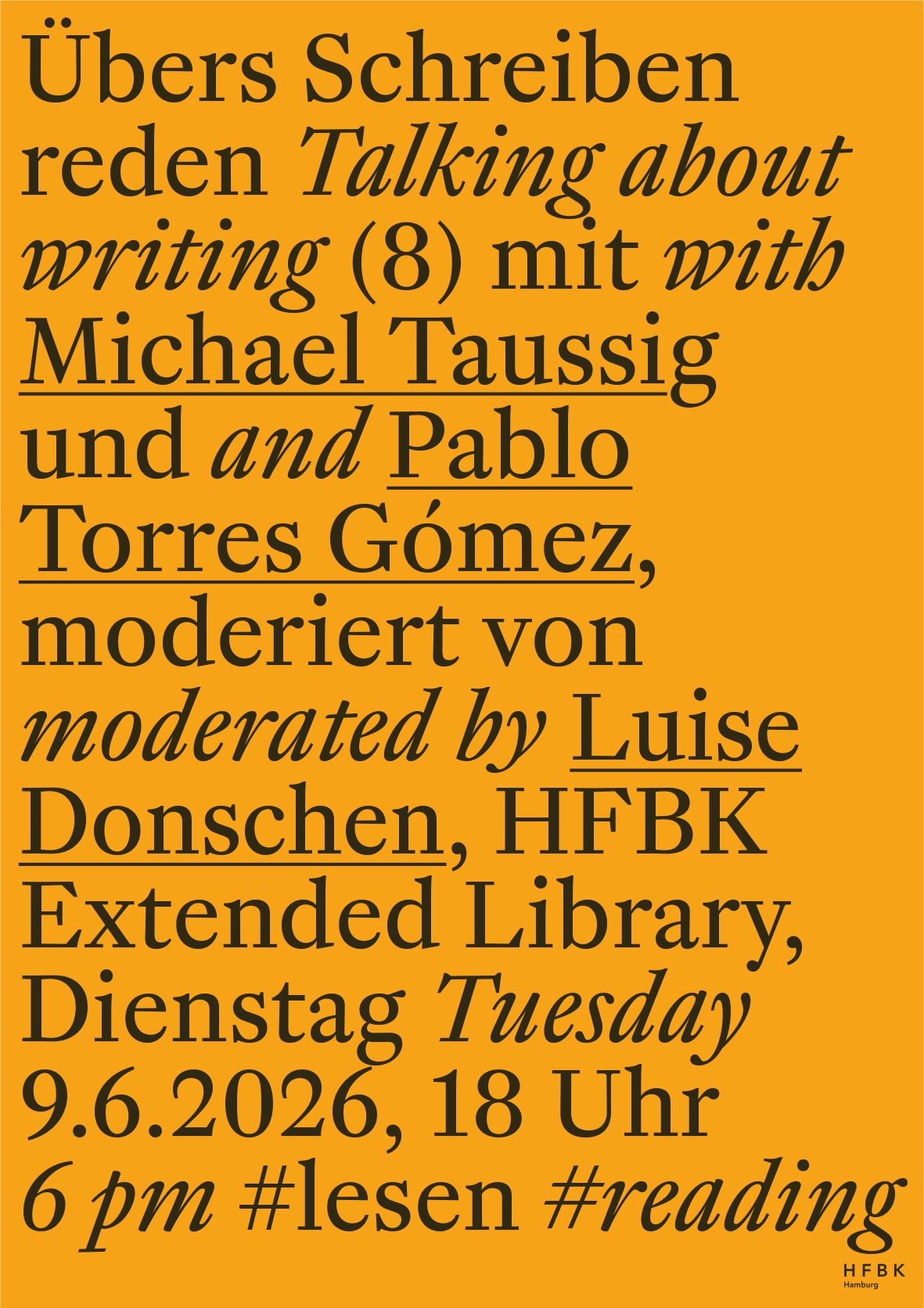
6 p.m.: Lecture Performance von Ruxin Liu
8 p.m.: Dinner
Laurel Chokoago, Aleen Solari, Sudabe Yunesi u.a.
18:00 Uhr