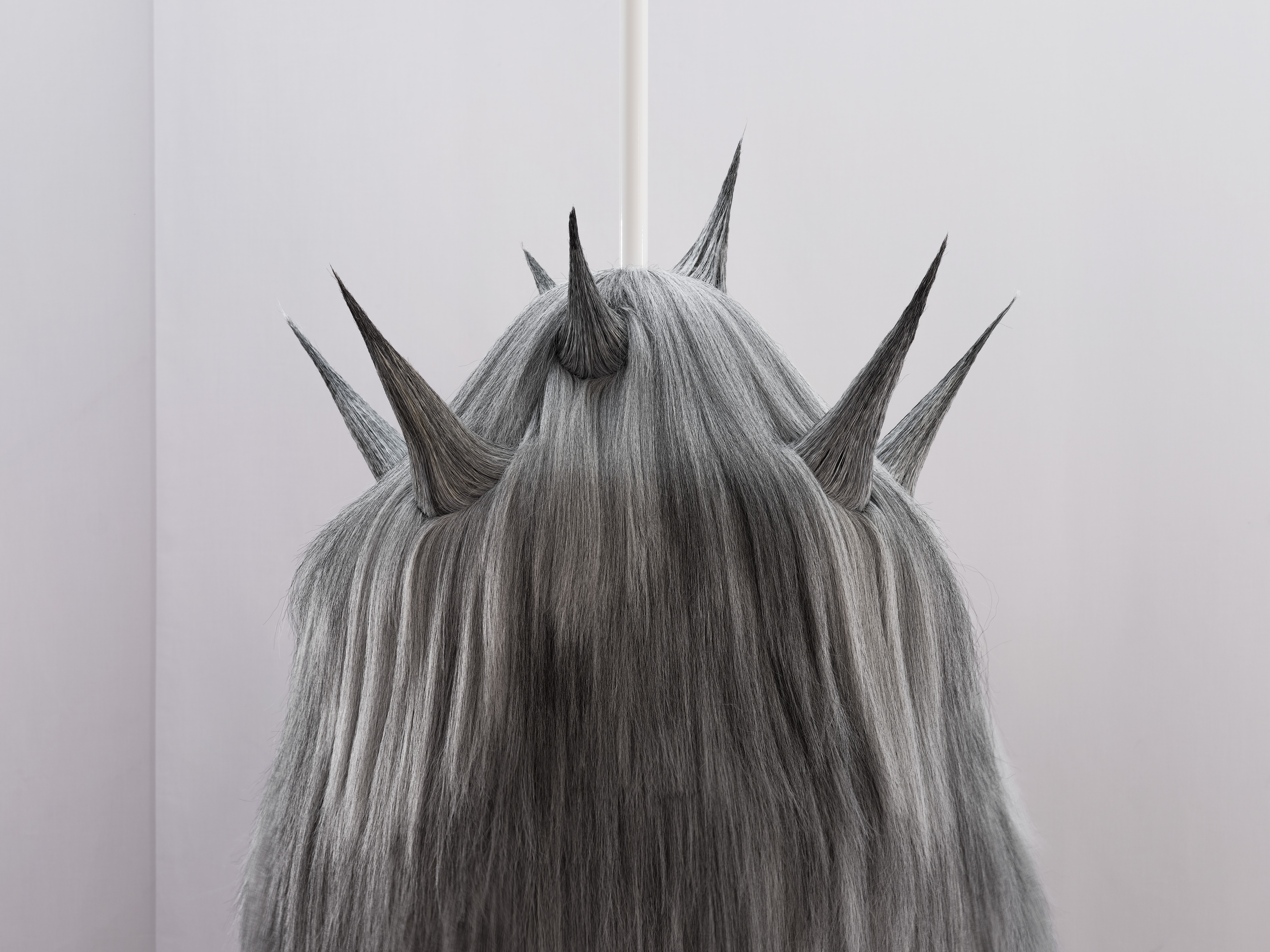
Jenna Sutela, Aeolian Suite (detail), 2026, Finnischer Pavillon, Biennale di Venezia 2026; Foto: Ugo Carmeni
Moving through water
Moving through water
Nada Rosa Schroer: Your work follows watery matter through a remarkable variety of bodily and other fluids. I’d like to begin with your personal relationship to water. Which bodies of water have shaped you?
Jenna Sutela: I should mention the idea of the “hypersea”, introduced by the geologists Dianna and Mark McMenamin in the 1990s. According to their thinking, terrestrial organisms are bonded by the fact that our body fluids commingle and that this connectedness forms a sea on land through which other organisms and nutrients can move. Funnily, all I can think of is books, even though I grew up by the sea. But I have read Moominpappa at Sea so many times. In this Tove Jansson classic, the protagonist Moomin tries to understand the vast and indifferent entity that is the sea—obviously only to fail miserably.
Nada Rosa Schroer: Speaking of the hypersea, wetness and fluidity have permeated ideas, methods and materials of your practice for more than a decade. I’m thinking of the slime mould Physarum polycephalum navigating the mazes of Orgs (2015); “wetware” and biological computing in works such as Gut-Machine Poetry (2017); saliva creating a fermentation environment in Spit Drink (2021) as well as synthetic human milk in HMO Nutrix (2022) or the water-filled vessels of Pond Brain (2023), resonating with more-than-human and even otherworldly vibrations. Looking back, how do you see these different fluids speaking to one another?
Jenna Sutela: I call these works living sculptures. Almost all my work includes chance elements or evolving structures, being both live and alive—so it’s not only my work but somehow emergent of collaboration with the universe (I say this half-jokingly, but I also mean it). A living sculpture can mean as much a musical instrument or a fountain as hardware, software, or wetware.
Nada Rosa Schroer: Beginning in winter semester 2026/27, you will join HFBK Hamburg as a Research Professor. Your position will eventually be supported through the Cluster of Excellence BlueMat: Water-Driven Materials, which HFBK is joining together with the University of Technology and the University of Hamburg. What questions and methods from your artistic practice are you interested in developing further in this interdisciplinary context?
Jenna Sutela: I understand it as an environment for open inquiry. Basic science, like art, is not tied to any particular application. At best, they are both able to focus on things-in-themselves, beyond their use value. The role of artistic research should be to hold that kind of space exactly—space for critical thinking, imagination and new practice. One of my areas of interest, for sure, is the setting itself. The connections between the class and the research cluster are free to take shape organically. So far, I’ve been in touch with a person from the electron microscopy unit at the University of Technology regarding some experiments in imaging and had a philosophical discussion with a physicist dealing with noisy data. The approach, from an art perspective, will be first and foremost conceptual and, perhaps, systemic—looking not only into water across scales but reflecting on the role of science and art in society as well.
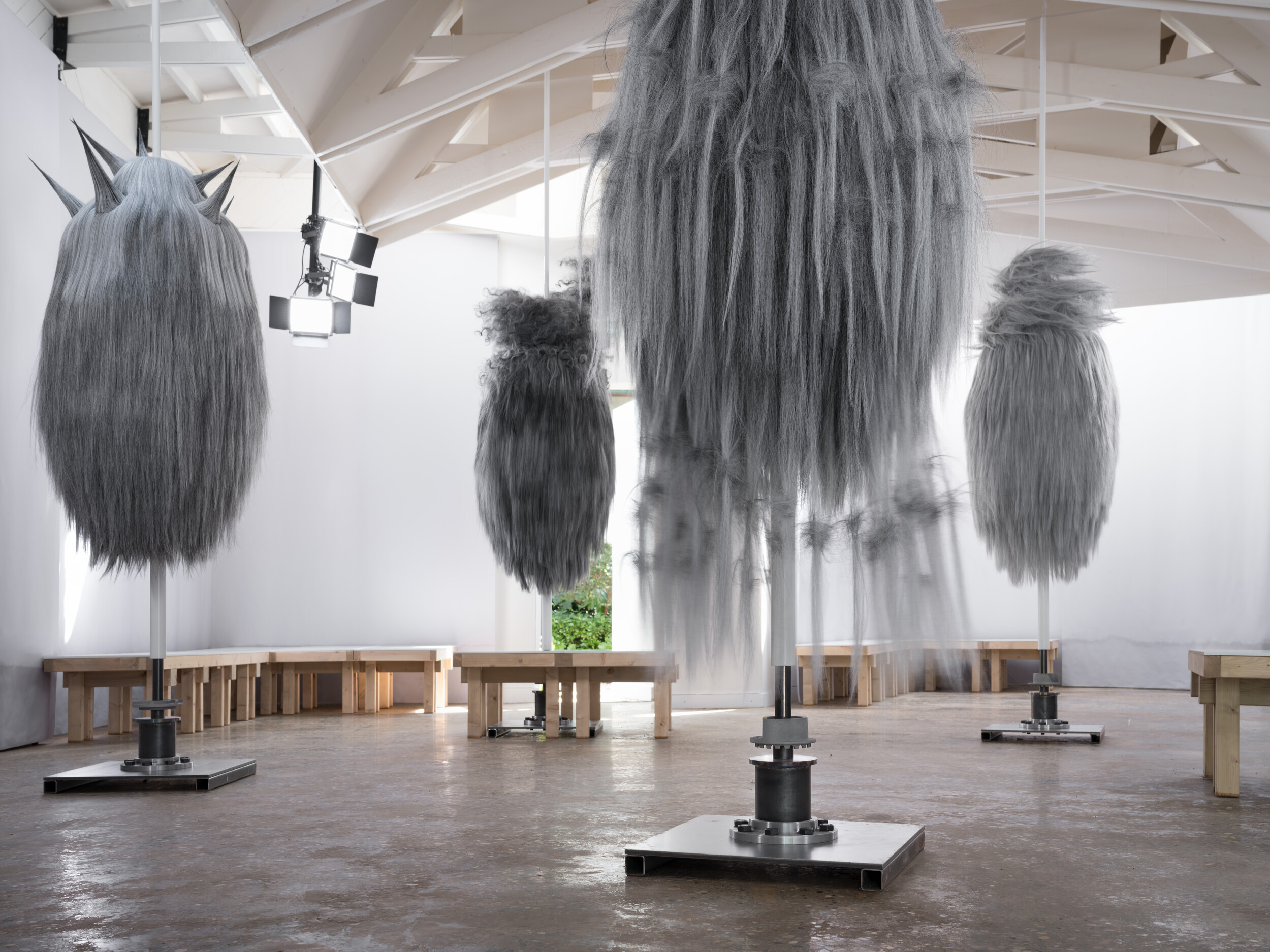
Jenna Sutela, Aeolian Suite, 2026, Finnischer Pavilion at Biennale di Venezia 2026; Foto: Ugo Carmeni
Nada Rosa Schroer: While opening up spaces of critical inquiry and imagination, the waters that form part of your living sculptures are never simply H₂O—what Jamie Linton has called “modern water”: a measurable, manageable substance separated from its social and ecological relations. Your waters, by contrast, tend to form lively, open environments with organisms, materials and technologies. In BlueMat, you will encounter water differently: as a “working fluid” whose properties inspire new materials, but also as highly purified “technological water” produced under the controlled conditions of the laboratory. As aquatic systems will stay in the focus of your future research, what kinds of waters are you interested in working with?
Jenna Sutela: Water can be encountered in many different ways in the context of the class. My own tendency would be to zoom out to the non-manageable waters, which would always be in relation to any kinds of “working fluids” too. In my work, ‘water-driven materials’ can of course involve water in its literal, liquid form—the flow and shape that it takes in a fountain, say—but they can also mean something further removed: sound recordings of wind governed by the uneven heating of the Earth’s oceans, or a melancholic piece of writing produced on a rainy day. Just to say that I see water as a connective tissue—something that lets me move between the scale of planetary weather systems and the scale of the body or emotion without treating either as more ‘real’ than the other. And then there´s the “virtual water” hidden in the infrastructures we think and work with. It remains to be seen what’s interesting from the point of view of the art students and artistic researchers joining the class.
Nada Rosa Schroer: In this context, notions of collaboration and co-creation play a central role—they long have been key aspects of your practice. You have worked with scientists, programmers and engineers, each bringing different ways of knowing and working. How do you create a shared process across these different epistemological fields?
Jenna Sutela: Based on my experience, in art-science collaborations, a big part of it is about establishing some kind of a common language—and possibly a workflow—between people from different fields. Translation skills can be useful when viewing art practice as part of an expanded ecosystem or when looking for new frameworks for art making and existing within the field.
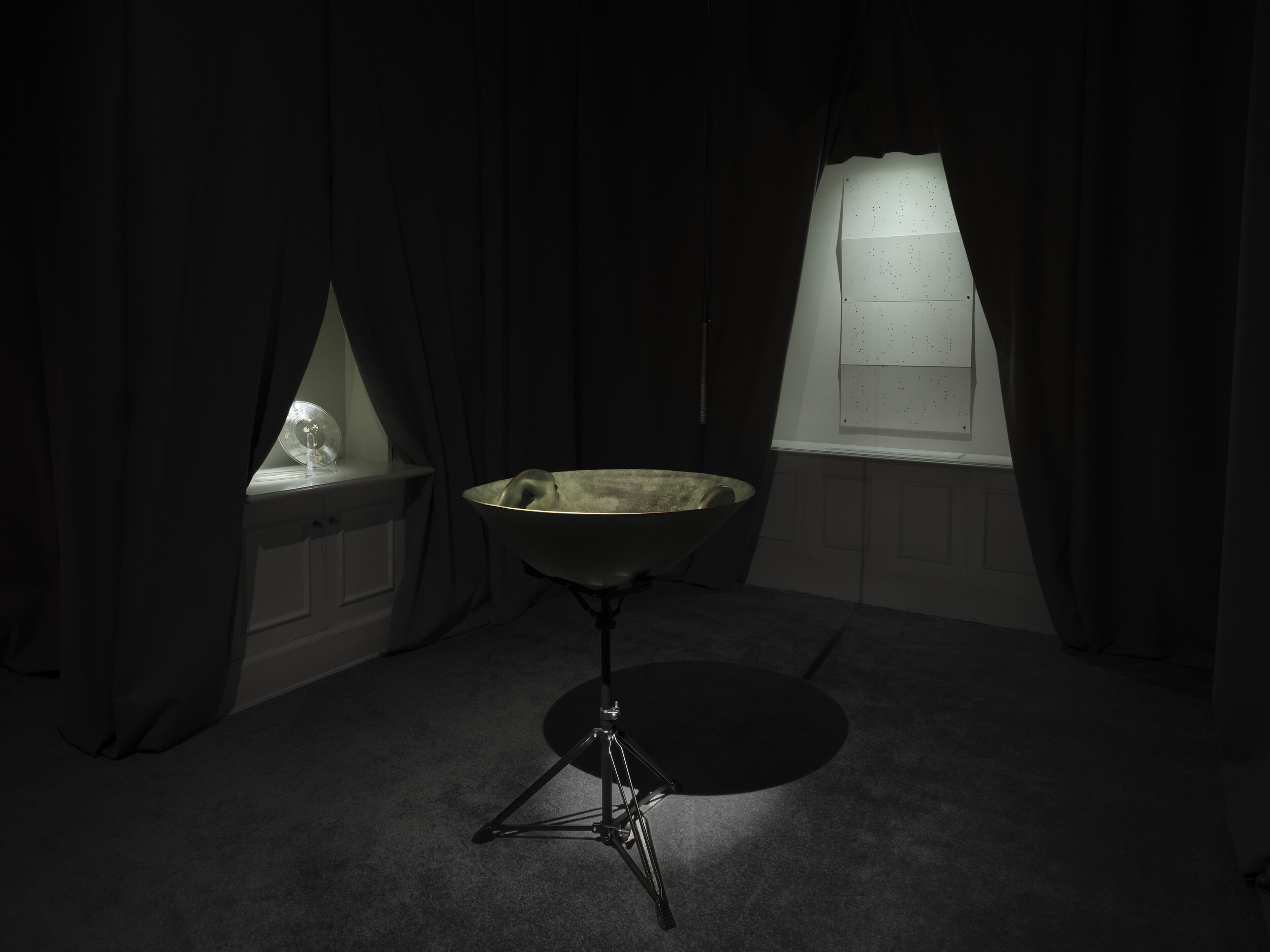
Jenna Sutela, With each cycle, a brain, Nicoletta Fiorucci Foundation, London, 2026; Foto: Eva Herzog
Nada Rosa Schroer: Could you share some thoughts about bringing artistic experimentation into rather controlled settings such as the laboratory? How do you perceive the relation between control and contingency?
Jenna Sutela: I mean, contingency is basically about outcomes depending on conditions that weren’t fully specified or controlled for. It’s a matter of possibility and dependency. And true to life, in that sense. There are other concepts I keep coming back to in my work too, like chaos or noise. They’re all, in different ways, signs of life in a system: evidence that it’s still in touch with the world, marking what wasn’t fully knowable in advance, what slipped past measurement, what played out on its own terms. I use that word (system) on purpose, thinking from the lab’s point of view.
Nada Rosa Schroer: Your collaborators also include slime moulds, bacteria, enzymes, algorithms and atmospheric phenomena that actively shape the work. How has working with these more-than-human agents changed your understanding of collaboration and artistic authorship?
Jenna Sutela: For me, it’s mostly a matter of focusing on the elements and other consciousnesses that play a role in our thinking and feeling. Through the gut-brain axis, for example. I’ve also ingested slime mould—known for its spatial intelligence—as part of a performance, a kind of speech act, letting it steer the narrative. This isn’t about not taking accountability for the outcomes of our own ideas or creations, but about recognizing the interdependencies we live with. So too with algorithms and, say, the weather.
Nada Rosa Schroer: In your earlier works you experimented with machine learning to bring different forms of intelligence into contact: in nimiia cétiï (2018), an artificial neural network responds to bacterial movement; in I Magma (2019), machine vision searches for meaning in moving liquids; and in Pond Brain (2023), a generative sonic landscape resonates with an instrument-fountain. In Aeolian Suite (2026), however, AI as co-collaborator seems to recede in favor of devices for listening and sensing to atmospheric movements. Later works might take up the topic of AI—always critically—while withholding its use from the work itself. Aeolian Suite (2026), for example, treats meteorological data as notation, reflecting on the role of machine learning in atmospheric science without putting it to use in the piece.
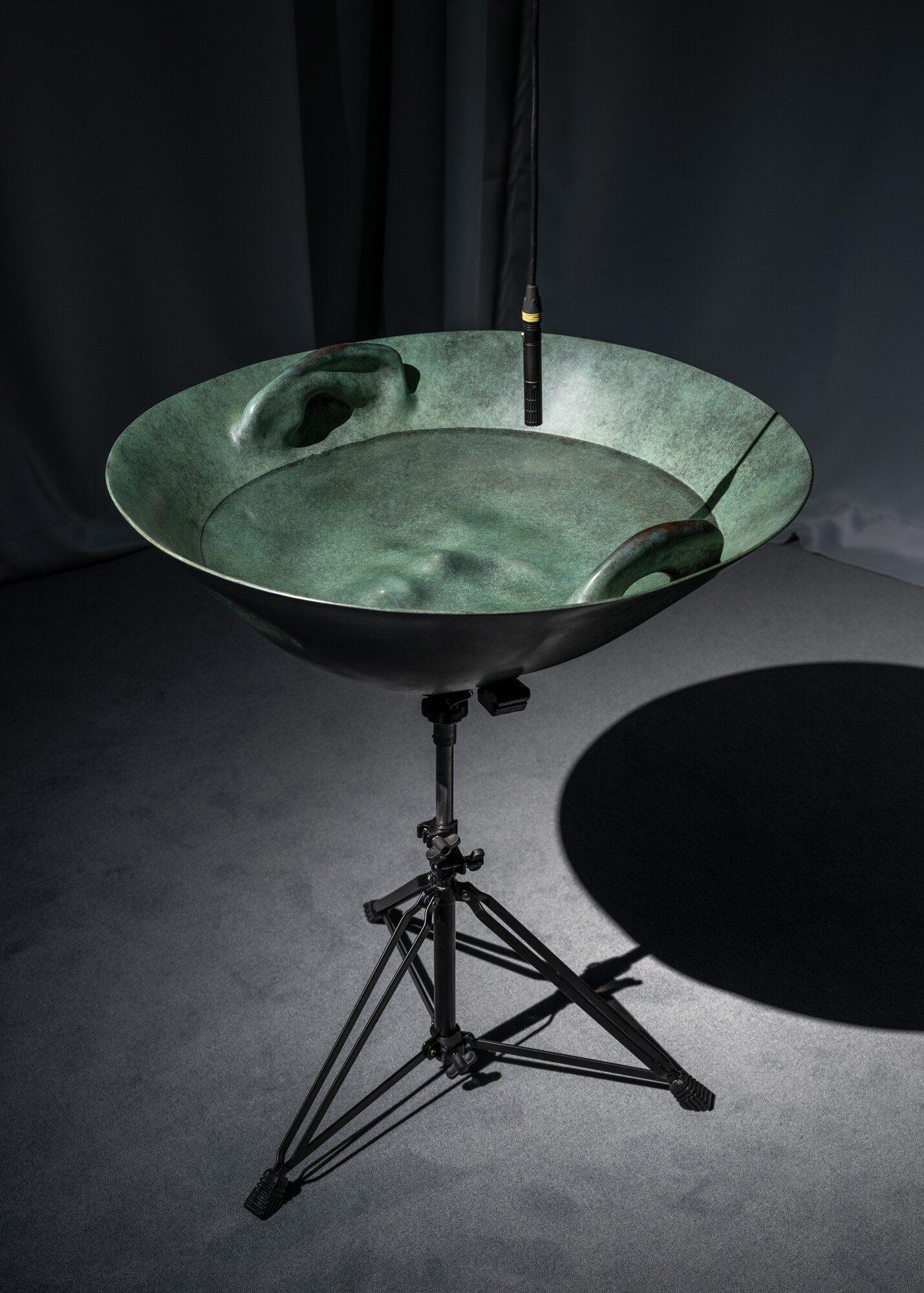
Jenna Sutela, Pond Brain, 2023; Foto: David Stjernholm, Copenhagen Contemporary
Jenna Sutela: At the time—and this was eight years ago, which feels like worlds away—I got a chance to experiment with artificial neural networks. They still played a relatively small role in the media landscape back then. A lot has happened in technology and the world between 2018, when I made nimiia cétiï, and now. Considering the environmental and social costs of the all-pervasive technologies that we live with, I think we need to pay extra attention to the kinds of technologies used in artistic production and, for example, opt for self-made or decentralized technological frameworks whenever possible. My friend Kei Kreutler recently wrote about a threshold moment in which technology increasingly predicts culture rather than the other way around, shifting the question from „What will technology do in the future?“ to „What does human sensing do now?“ I often think about this, like I think about the role of lenses such as the microscope or the telescope in observing phenomena in a lab setting. Or how the multidimensional ways of looking conditioned by artificial neural networks change our perception and, ultimately, our sense of reality itself.
Nada Rosa Schroer: With this awareness of technological thresholds, you seem to approach technology with curiosity rather than simple optimism or scepticism. What other forms of perception and knowledge can artistic inquiry bring into fields of technological research that are often oriented towards innovation and solution-making? How might art complicate or expand their underlying assumptions and approaches?
Jenna Sutela: In my work for the Venice Biennale this year, I was exploring how meteorological technologies shape the weather—how, bitterly, better weather predictions require more computing power, which creates more CO2 and makes weather more extreme and unpredictable. In recent years, I’ve been applying an approach to art making that I call ‘tech povera’. It’s a practice of undressing the black box and viewing the materiality of media as a site of meaning.
Nada Rosa Schroer: To return to where we started our conversation: Perhaps watery matter itself can be thought of as a medium, carrying and transmitting matter and meaning across bodies, places and deep timescales. How does thinking with water shape your understanding of systems, space and time? What does it open up for you artistically, spiritually or ethically?
Jenna Sutela: Thinking about water, body fluids and also water at scale, has played a role in a lot of my work. Moving through boundaries, water reveals them as thresholds rather than edges. This helps to see things not as fixed objects but as sites of continuous exchange—which is, in the end, a way of thinking through open and relational systems. I feel like what drives me is the ecological understanding of existence as fundamentally interconnected: with each other and a planet that’s not our own.