This website uses cookies to display external content and to collect anonymous statistics on usage behavior.
Ongoing Events
Thu, 27 Aug 2026—
Wed, 21 Oct 2026
Exhibition
A R T I N T R A N S I T - T H E E X P E R I E N C E OF E L S E W H E R E
THE SPACE //, Hamburg
Jaakov Blumas, Miwa Ogasawara, Nanhee Kim, Stina Stühmer, Zangman u.a.
Sat, 26 Sep 2026—
Sat, 24 Oct 2026
Exhibition
The Appearance of Value
Hafen gallery, Berlin
Lazar Stojic a.o.
Sun, 4 Oct 2026—
Sat, 24 Oct 2026
Exhibition
TXT
Feinkunst Krüger, Hamburg
Theo Huber, Stefan Vogel, Anja Kaiser a.o.
Sat, 10 Oct 2026—
Sun, 25 Oct 2026
+ – »wenn morgen die sonne nicht mehr aufgeht«
Künstler*innenhaus FRISE, Hamburg
Luzie A.C. Katzorke, Philine Mayr
Artist Talk: 25. Oktober 2026, 15 Uhr
Fri, 18 Sep 2026—
Fri, 30 Oct 2026
Exhibition
Liebe Grüße, Jenny
Galerie kleine gegenwart, Hamburg
Jenny Schäfer
Fri, 18 Sep 2026—
Fri, 30 Oct 2026
Exhibition
Liebe Grüße, Jenny
Galerie kleine gegenwart, Hamburg
Jenny Schäfer
Thu, 3 Sep 2026—
Fri, 30 Oct 2026
Exhibition
POSE TO ROSE
Galerie Mathias Güntner, Hamburg
Thorsten Brinkmann
Sun, 18 Oct 2026—
Sat, 31 Oct 2026
Swing Life
Raum linksrechts, Hamburg
Tariano Schneider, Helena Walter, Maja Wietfeldt u.a.
Fri, 18 Sep 2026—
Sun, 1 Nov 2026
Exhibition
+ – Wer schnupft am Schönsten?
HFBK boutique, Hamburg
Elisa Maria Zeisler
As part of Wer schnupft am Schönsten? at HFBK boutique, Elisa Maria Zeisler constructs a room that houses an immersive installation. The installation draws on the extensive history of Bavarian snuff tobacco clubs (Schnupftabakmeisterschaften), tracing back to the 1960s – a community the artist entered by founding her own club in 2024 in Hamburg. Bringing the neon-coloured sports jerseys of her club into the microcosm of an old-fashioned Bavarian tavern, richly decorated with embroidered cloths and taxidermy trophies and populated by men in Lederhosen, Zeisler opens a dialogue between tradition and novelty. The work reflects on the tension between the scene’s conservative, patriarchal undercurrents and the voices of a younger generation.
The set itself becomes the subject of the work through its spatial arrangement: half of the exhibition space remains empty, revealing the otherwise hidden back of the set. This makes the set visible as a construction and, at the same time, exposes the boundary between the depicted world and its staging.
The video work shown alongside the installation documents the artist’s journey into the world of snuff tobacco clubs, driven by her long-standing interest in stepping into psychological and physical spaces usually hidden from the general public. Zeisler’s artistic practice recreates these niche spaces within a gallery, allowing viewers to step inside and experience them firsthand.
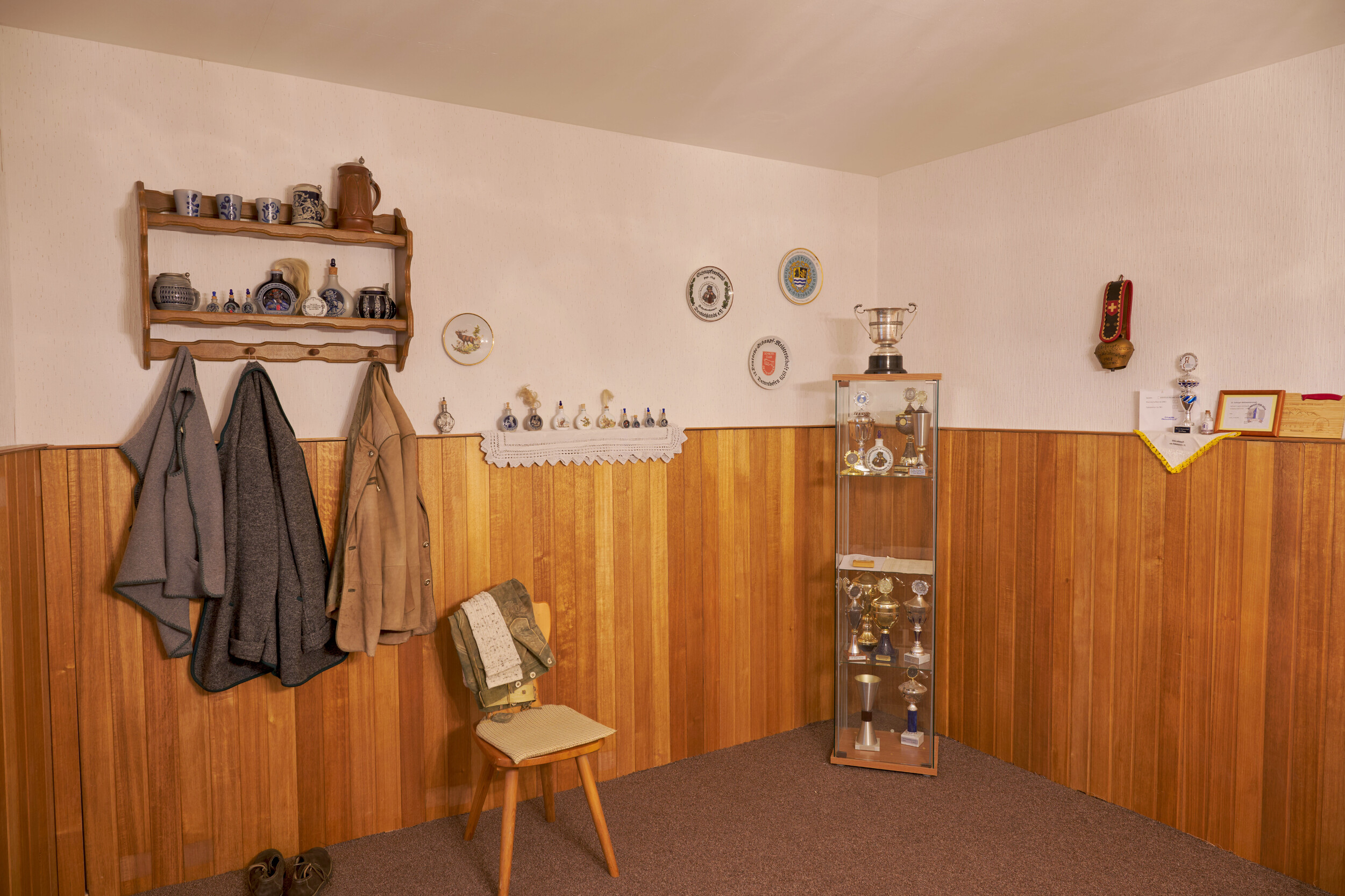
Artwork by Elisa Zeisler at Graduate Show 2025; photo: Tim Albrecht
Fri, 9 Oct 2026—
Wed, 4 Nov 2026
No One Leaves Home Unless
Q.E.D. Gallery, Hamburg
Serafima Bresler
Thu, 10 Sep 2026—
Sun, 8 Nov 2026
Exhibition
Projektionen auf den Osten
neuer berliner kunstverein
Jasmin Werner u.a.
Sat, 5 Sep 2026—
Sun, 8 Nov 2026
Exhibition
Temper
Kunsthaus Hamburg
Yalda Afsah
Sat, 19 Sep 2026—
Sun, 8 Nov 2026
Exhibition
Widerstand und Wunden. Eine Ausstellung zu genderspezifischer und s**ualisierter Gewalt
Künstler*innenhaus Dortmund
Suse Itzel a.o.
Sat, 3 Oct 2026—
Sun, 15 Nov 2026
Exhibition
exhibition
Kunstverein Harburger Bahnhof, Vitrinen auf Gleis 3/4, Hamburg
Yufan Chen, Chantal Kaufmann, Sunkyu Lee, Genevieve Lotus, Luka Naujoks, Maren Stocklöw, Anna Stüdeli
Fri, 9 Oct 2026—
Sun, 15 Nov 2026
Exhibition
+ – Under Construction
Di. - So., 14:00-18:00 Uhr
ICAT, HFBK Hamburg
Catalina González González, Maik Gräf, Moshtari Hilal, Nabila Horakhsh, Grit Richter, Annegret Soltau, Aimilia A. Theofilopoulos & Lio Kappel, Alison Umeh, Jasmin Werner, Maja Wietfeldt
An Exhibition on the Construction of the Self and the Body
The exhibition Under Construction explores the body as a space of experience and a site of social influences. Through photographs, textile works, installations, and films, ten artistic practices reflect on how the perception of the self and the body is constantly shifting. The self emerges as a processual, relational construction in which memory, emotion, movement, and attributions play a significant role. A textile labyrinth allows visitors to experience these processes spatially: paths branch off, views are blocked, and visitors are prompted to pause or turn back.
Curated by Anne Meerpohl


Subevents
Thu, 08.10.26
Eröffnung
18:00 Uhr
Fri, 23.10.26
Workshop
+ – A Piece of Me
3:00 pm
Nabila Horakhsh
Textile art workshop by Nabila Horakhsh
A Piece of Me is a participatory, conceptual, and experimental installation based on the collection, stitching, documentation, and connection of pieces of fabric from diverse cultures, geographies, and personal narratives. The project reconsiders the mystical concept of “unity” through the idea that every individual is a piece of a larger collective body.
Through a series of workshops, participants are invited to bring a personal piece of fabric or clothing that carries a memory, experience, cultural connection, or personal significance. They transform their pieces through textile art practices such as stitching, embroidery, calligraphy, painting, printing, beadwork, patchwork, and other experimental techniques.
The workshop creates a space for participants to meet, exchange stories, and reflect on their individual identities while creating. Each piece becomes an expression of its maker—preserving its own color, texture, memory, and identity.
The pieces created during the workshops are then collected, documented, connected, and assembled into a large-scale textile installation. Individually, each piece represents a personal story; collectively, they form a larger body.
Nabila Horaksh is an ArtsLink Fellow 2026 co-hosted by HFBK Hamburg and Arteeast, New York, NY. ArtsLink Fellowships is a CEC ArtsLink program, based in the US, supporting pioneering transnational artists, curators, and arts leaders to develop creative community-engaged practices in the US and across borders.
Artist Talk
+ – Artist Talk Nabila Horakhsh & Lila Nazemian
6:00 pm
Nabila Horakhsh, Lila Nazemian
Nabila Horaksh is an ArtsLink Fellow 2026 co-hosted by HFBK Hamburg and Arteeast, New York, NY. ArtsLink Fellowships is a CEC ArtsLink program, based in the US, supporting pioneering transnational artists, curators, and arts leaders to develop creative community-engaged practices in the US and across borders.
Sat, 24.10.26
+ – Live Concert
5:30 pm
ICAT, HFBK Hamburg
With Azim Haydari, Walid Zarif, Samimulla Sayafullah
Invited by Nabila Horakhsh & Lila Nazemian
Sun, 15.11.26
Guided Tour Exhibition
+ – Finissage
4:00 pm
With curatorial guided tour (in German)
Sat, 9 May 2026—
Sun, 22 Nov 2026
Exhibition
+ – In Minor Keys - 61st International Art Exhibition of La Biennale di Venezia
different locations in Venice
Kader Attia, Sung Tieu, Henrike Naumann, Yalda Afsah, Jenna Sutela a.o.
Sun, 6 Sep 2026—
Sun, 29 Nov 2026
Exhibition
das blaue vom himmel
Saasfee*Pavillon, Frankfurt
Anna Oppermann
Sun, 4 Oct 2026—
Sun, 6 Dec 2026
Exhibition
+ – Generate & Decouple
Galerie im Marstall Ahrensburg
Saskia Senge u. a.
Fri, 18 Sep 2026—
Sun, 6 Dec 2026
Tobacco Echoes
Global Heritage Lab, Universität Bonn
Ngozi Ajah Schommers
Sun, 11 Oct 2026—
Sat, 12 Dec 2026
Exhibition
+ – All my Love, Lulu x
Galerie in der Wassermühle Trittau
Lulu MacDonald
Performance at 5.00 pm by Lulu MacDonald and Nora Strömer
Fri, 18 Sep 2026—
Sun, 13 Dec 2026
Exhibition
+ – Geste und Kostüm. Das barocke Portrait damals und heute
Emslandmuseum Schloss Clemenswerth, Sögel
Thorsten Brinkmann a.o.
Sat, 17 Oct 2026—
Mon, 4 Jan 2027
Wartezimmerkunst
Grundbuchhalle, Ziviljustizgebäude, Hamburg
Carlo Sprung
Sat, 19 Sep 2026—
Sun, 17 Jan 2027
Exhibition
Tell Me Where Home Is
Kunstmuseum Wolfsburg
Kader Attia, Grit Richter a.o.
Sat, 3 Oct 2026—
Sun, 31 Jan 2027
Exhibition
thinking through your cracks and veins
Kunstverein Harburger Bahnhof, Hamburg
Paula Hummer a.o.
Thu, 1 Oct 2026—
Mon, 1 Feb 2027
Professionalization
+ – HFBK Professionalization Program Winter Semester 2026/27
HFBK Hamburg and Online
The HFBK’s professionalization program aims to equip students and graduates with the knowledge and skills they need to position themselves confidently in the art world. The program is designed specifically for freelance artists and provides them with the professional knowledge they need to meet the complex demands of working as an independent artist. The goal is to enable participants to operate in the art world in an informed and confident manner, thereby smoothing the transition from study to professional life. The professionalization program is affiliated with ICAT, which brings together the HFBK’s research activities and incorporates artistic issues into current social discourse in a sustainable manner.
The free program, which is aimed at students and graduates of the HFBK up to five years after graduation, includes information events, lectures, and workshops on the topics of artistic positioning, presentation, financing, networking, management, law and contracts, marketing, social security, and taxes. We are also happy to advise you on individual questions within these subject areas, review your portfolio together, and answer questions about your application documents.
The program also includes regular events on sustainability, diversity, and international topics. Marked events from the program (*Microcredential) can be certified for graduates with microcredentials. The events are a consistent component of the university’s offerings in the context of “lifelong learning.” They enable participants to flexibly and effectively deepen their knowledge of individually important learning modules.
Subevents
Mon, 02.11.26
Professionalization Workshop
+ – No-Procrastination Club – eine Peer-Coaching Reihe
10:00 am
Lerchenfeld 2, Raum K51
Dr. Lima Sayed
2. November 2026 bis 1. Februar 2027, 12 Termine montags 10:00–11:30 Uhr
Deutschsprachiges Angebot
*Microcredential Diversität
Künstlerisches Arbeiten braucht Freiheit – und Struktur. Zwischen Projektideen, Studium, Atelierarbeit, Abgaben und eigenen Ansprüchen kann es herausfordernd sein, den Überblick zu behalten, ins Tun zu kommen und Vorhaben konsequent weiterzuverfolgen. Wie gelingt es, eigene Projekte nachhaltig voranzubringen, hilfreiche Arbeitsroutinen zu entwickeln und auch bei Zeitdruck, Selbstzweifeln oder Perfektionismus im Prozess zu bleiben?
In diesem fortlaufenden Peer-Coaching-Format geht es darum, Isolation zu durchbrechen und eine Kultur der konstruktiven Kooperation zu stärken. Wir wollen voneinander und miteinander lernen, uns gegenseitig unterstützen und gleichzeitig an unseren individuellen Zielen arbeiten. Mithilfe verschiedener Impulse und Reflexionsübungen erkunden wir den eigenen Status quo, machen uns unsere Stärken, Potentiale und Werte bewusst, entwickeln individuelle Strategien und bringen eigene Projekte Schritt für Schritt voran.
Im Mittelpunkt stehen Selbstorganisation, Arbeitsstruktur und Routinen ebenso wie der Umgang mit Motivationsproblemen und Prokrastination. Ziel ist es, die eigene künstlerische Praxis bewusster zu gestalten, mehr Sicherheit im Umgang mit Hindernissen zu gewinnen und Arbeitsprozesse bewusster und kollaborativer zu gestalten.
Dr. Lima Sayed ist als Beraterin für psychosoziale Unterstützung und Diversität an der HFBK tätig. Als systemischer Coach mit Expertise in den Bereichen Diversität, Gleichberechtigung und Inklusion verfügt sie über langjährige Erfahrung in der Hochschulberatung. Neben ihrer institutionellen Tätigkeit arbeitet sie freiberuflich als Diversity-Trainerin und Karriereberaterin. In dieser Funktion konzipiert und leitet sie Workshops, die Studierende dabei unterstützen, ihren beruflichen Weg zielgerichtet und authentisch zu gestalten.
Anmeldung ab 1. Oktober 2026 hier.
Wed, 04.11.26
Lecture Professionalization
+ – Die Künstlersozialkasse (KSK)
10:00 am
Online
Fred Janssen
Deutschsprachiges Angebot
Niemand kommt als Selbständiger so günstig in die Krankenkasse wie freie Künstler*innen und Publizist*innen: Sie müssen sich nicht freiwillig gesetzlich und überteuert absichern, sondern bekommen die Hälfte der Beiträge als Zuschuss von der Künstlersozialkasse. Und die Rente wird von der KSK auch noch bezuschusst – insgesamt erhält man von der KSK so mehrere tausend Euro pro Jahr. Doch was sind die Voraussetzungen, wer wird überhaupt in die KSK aufgenommen?
Fred Janssen wird darüber berichten. Er ist seit über 35 Jahren Mitarbeiter der Künstlersozialkasse und war in den Bereichen Versichertenrecht, Künstlersozialabgabe, Betriebsprüfung tätig. Sein jetziges Aufgabenfeld liegt im Bereich des Wissensmanagements, Auskunft und Beratung/Öffentlichkeitsarbeit.
Diese Veranstaltung ist geöffnet für Studierende von zahlreichen Kunst- und Musikhochschulen in Deutschland, Österreich und der Schweiz.
Anmeldung ab 1. Oktober 2026 hier.
Fri, 06.11.26
Workshop Professionalization
+ – Kunst als kommunikatives Handeln
10:00 am
Lerchenfeld 2, Raum 213 a/b
Martin Karcher
6./27. November 2026, jeweils 10–14 Uhr
Deutschsprachiges Angebot
Der zweitägige Workshop beschäftigt sich mit der Frage, wie sich die eigene künstlerische Praxis in unterschiedlichen professionellen Kontexten versprachlichen und vermitteln lässt. Im Mittelpunkt stehen verschiedene Formen des Sprechens und Schreibens über die eigene Arbeit sowie die unterschiedlichen Situationen, Adressierungen und Erwartungen, die damit verbunden sind. Anhand konkreter Formate – darunter Artist Statement, Werkbeschreibung und Ausstellungstext – werden unterschiedliche Modi künstlerischer Kommunikation erprobt und reflektiert. Ein offener Teil zu Beginn des Workshops dient dazu, konkrete Fragen und Bedürfnisse der Teilnehmer*innen aufzunehmen.
Dr. Martin Karcher ist Erziehungswissenschaftler, Kurator und Autor. Von 2022 bis 2026 war er Assistenzkurator am Kunstverein in Hamburg. Seine Arbeit bewegt sich an den Schnittstellen von zeitgenössischer Kunst, Bildung und kritischer Theorie und umfasst kuratorische Praxis, Publikationen sowie Lehr- und Vermittlungsformate. Er promovierte im Bereich Allgemeine Pädagogik und lehrt regelmäßig an unterschiedlichen Universitäten.
Anmeldung ab 1. Oktober 2026 hier.
Mon, 16.11.26
Lecture Panel Discussion
+ – Aufenthaltsoptionen nach dem Studium für internationale Studierende
10:00 am
Online
Sebastian Hoffmann von touring artists
Deutschsprachiges Angebot
Was sind die Optionen für die Zeit nach dem Studium, um weiterhin in Deutschland zu bleiben und als Künstler:in zu arbeiten? In diesem Workshop wird Sebastian Hoffmann von der Informations- und Beratungsstelle touring artists (https://www.touring-artists.info/) einen Input zu den aufenthaltsrechtlichen Möglichkeiten geben, mit einem Fokus auf den Aufenthalt als freiberufliche:r Künstler:in. Zusätzliche Themen werden die Wege zur Niederlassungserlaubnis und Einbürgerung sowie die Mobilität innerhalb der EU sein.
Sebastian Hoffmann koordiniert das touring artists-Beratungsangebot zu den administrativen Regelungen des grenzüberschreitenden Arbeitens im Kulturbereich (alle Sparten) sowie zu Fragen von Visa und Aufenthaltsstatus für Künstler:innen aus Nicht-EU-Ländern. touring artists ist ein Gemeinschaftsprojekt der Internationalen Gesellschaft für Bildende Künste/IGBK, des Internationalen Theaterinstituts/ITI – Zentrum Deutschland und des Dachverbands Tanz.
Anmeldung bitte unter Angabe der Hochschule an anna.bernlochner@hmt-rostock.de
Ein Netzwerkangebot des Career Service der hmt Rostock.
Workshop Professionalization
+ – Inklusive Kunstvermittlung - Ausstellungen für Blinde und Sehbehinderte zugänglich machen
5:00 pm
Lerchenfeld 2, Raum 213 a/b
Agatha Kosobucki
16./23. November 2026, 17–19:30 Uhr
Deutschsprachiges Angebot
*Microcredential Diversität
Ausstellungen richten sich zumeist an ein sehendes Publikum. Wie können Kunstwerke und Ausstellungsräume so konzipiert werden, dass unterschiedliche Formen der Wahrnehmung mitgedacht werden?
Der Workshop vermittelt Grundlagen des Universal Designs und der barrierefreien Kunstvermittlung mit dem Schwerpunkt Blindheit und Sehbehinderung. Gemeinsam betrachten wir, welche Barrieren in Ausstellungen entstehen und wie diese durch einfache gestalterische Entscheidungen reduziert werden können.
Zunächst beschäftigen wir uns mit Blindheit, Sehbehinderung und unterschiedlichen Formen visueller Wahrnehmung. Eine kurze Simulation macht verschiedene Wahrnehmungssituationen erfahrbar. Wir lernen Grundlagen des barrierefreien Ausstellungsdesigns kennen, erproben haptische Vermittlungsformen nach dem 2-Sinne-Prinzip und erhalten eine praktische Einführung in die Brailleschrift an der Braille-Schreibmaschine.
Im zweiten Teil stehen Alternativtexte und Audiodeskription im Mittelpunkt. Anhand von Beispielen und praktischen Übungen erarbeiten wir, wie visuelle Inhalte präzise und zugänglich beschrieben werden können. In freiwilligen Fallbesprechungen besteht zudem die Möglichkeit, eigene Arbeiten oder Ausstellungskonzepte mitzubringen und gemeinsam individuelle Strategien für eine barrierearme Präsentation zu entwickeln – ohne dabei die künstlerische Position aus dem Blick zu verlieren.
Agatha Kosobucki ist bildende Künstlerin und Sonderpädagogin mit dem Schwerpunkt Blindheit und Sehbehinderung. Sie studierte Freie Kunst an der HFBK Hamburg sowie Blinden- und Sehbehindertenpädagogik an der Universität Hamburg. In ihrer künstlerischen Praxis verbindet sie Fragen der Wahrnehmung, Materialität und Inklusion und untersucht, wie Kunst jenseits des Sehsinns erfahrbar werden kann. Parallel arbeitet sie als Kunstlehrerin am Bildungszentrum für Blinde und Sehbehinderte Hamburg (BZBS).
Anmeldung ab 1. Oktober 2026 hier.
Fri, 20.11.26
Workshop Professionalization
+ – Finanzkompass: Finanzen verstehen, Spielräume schaffen
2:30 pm
Online
Jean-Marie Schwarzkopf
20./27. November 2026, 14:30–17:30 Uhr
Deutschsprachiges Angebot
*Microcredential Professionalisierung
Dieser Online-Workshop richtet sich an angehende Künstler*innen, die ihre finanzielle Situation bewusster gestalten möchten, auch wenn die Mittel begrenzt sind. Im Fokus steht ein realistischer Umgang mit Geld: Wie kann ich mit dem, was da ist, besser auskommen, und wo lassen sich kleine Spielräume schaffen? Zentrale Bestandteile sind dabei alltagstaugliche Strategien für den Umgang mit Einnahmen und Ausgaben und die Frage, was das Leben eigentlich kostet: von Miete über Strom bis hin zu laufenden Ausgaben. Darauf aufbauend werden einfache Wege vermittelt, um Fixkosten zu überblicken und den eigenen finanziellen Alltag besser zu strukturieren. Dabei wird auch auf die besonderen Herausforderungen unregelmäßiger oder projektbasierter Einkommen eingegangen.
Darüber hinaus werden zentrale Begriffe und Mechanismen aus dem Finanzsystem verständlich erklärt und kritisch eingeordnet. Themen wie Sparen, Investieren und Vorsorge werden dabei als Optionen vermittelt, die je nach Lebenssituation unterschiedlich sinnvoll sein können. In diesem Zusammenhang werden erste Einblicke in Anlageformen wie ETFs und Sparpläne gegeben, um eine Orientierung zu eröffnen, wie Geld langfristig eingesetzt werden kann, um die drohende Rentenlücke zu schließen.
Interaktive Methoden unterstützen den Lernprozess und schaffen Raum für Austausch, Fragen und unterschiedliche Perspektiven auf Geld. Ein kurzes Quiz dient der spielerischen Reflexion des eigenen Finanzwissens, während eine Simulation dazu einlädt, finanzielle Entscheidungen im Alltag durchzuspielen und gemeinsam auszuwerten.
Der Workshop zielt darauf ab, die Teilnehmenden in ihrer finanziellen Selbstbestimmung zu stärken und ihnen einen realistischen, alltagstauglichen Umgang mit Geld zu ermöglichen. Sie lernen, ihre eigene finanzielle Situation auch bei unregelmäßigem Einkommen besser einzuschätzen und daraus praktische Entscheidungen für ihren Alltag abzuleiten. Insgesamt stärkt der Workshop die eigene Urteilsfähigkeit in finanziellen Angelegenheiten und befähigt dazu, finanzielle Entscheidungen informiert und selbstbestimmt zu treffen sowie die eigene Situation auch im größeren gesellschaftlichen Zusammenhang zu verstehen.
Dr. Jean-Marie Schwarzkopf ist Experte für Finanzbildung und Preisträger des Deutschen Lehrkräftepreises. Mit über 25 Jahren Erfahrung verbindet er fundiertes Finanz-Know-how mit moderner Pädagogik. Als Lehrer am Gymnasium Eppendorf, Autor des Buchs Dein Finanzkompass und Dozent vermittelt er komplexe Wirtschaftsthemen praxisnah und verständlich. Sein Ziel ist es, Menschen zu befähigen, ihre finanziellen Entscheidungen selbstbestimmt zu treffen.
Anmeldung ab 1. Oktober 2026 hier.
Mon, 23.11.26
Lecture Professionalization
+ – Vitamin B - A supplement you need to build a career
10:00 am
Lerchenfeld 2, Room 213 a/b
Lulu MacDonald
English language offer
This lecture is a patchwork of everything I wish I knew when I started my career as a fine artist. I’ve made the mistakes so you don’t have to.
Networking? For me? No thanks. Surely, you just have to be talented, make good work and then one day someone will present you opportunities on a silver platter, right? Wrong.
Networking always seemed to me like a slimy concept. I thought networking was all about elbowing other people out of the way to get to the top, but I was wrong. In fact, it’s much more about building support structures, collaborating and supporting your peers to become a creative people want to work with.
During the course of this lecture, Lulu MacDonald interconnects and weaves anecdotes, stories she’s heard, moments of success, moments of accidents, coincidences and planned manipulations to show you that, in the creative sector, everything really does happen for a reason. She will present you with the tools and understanding you need to build yourself a network without feeling gross. And explains how everyone does it, they just keep it a secret!
Vitamin B is a lecture which presents insider knowledge on the art world and will openly and vulnerably explain how to build a loving support system for yourself. Prepare to feel empowered and more in control of your professional development. But also to learn that we aren’t on our own, even though it sometimes feels like it.
Lulu MacDonald completed her MA studies in 2017 at the HFBK Hamburg (class of Pia Stadtbäumer). Since then she has been working as a freelance artist and has presented her work at Å+ Gallery Berlin, Kunsthaus Hamburg, Museum für Kunst und Gewerbe Hamburg, Westfälischer Kunstverein Münster, MOM Art Space Hamburg, Hinterconti Hamburg, Galerie Wassermühle Trittau and Gastgarten Kunstverein Hamburg, among others.
Registration opens October 1, 2026, here.
Mon, 30.11.26
Workshop Professionalization
+ – Toolbox für Portfolio & Präsenz im Kunstfeld
10:00 am
Online
Birgit Effinger
November 30 and December 7, 2026, 10 a.m.–3 p.m.
Offer available in German and English.
You ask yourself:
How can I talk authentically about my art without compromising myself?
How can I present my artistic work in a personal and professional way, without resorting to clichés?
How can I successfully apply for grants, exhibitions, or residencies?
How can I navigate the transition after graduation and find the right networks?
In this two-day workshop, you’ll develop practical methods for communicating your artistic practice precisely, confidently, and purposefully—both verbally and in writing. Using your current projects as a basis, we’ll explore various forms of presentation and writing:
Concise Presentations: How do you succinctly summarize your work verbally?
Portfolio Review: Individual feedback on your portfolio & insights into review situations from a jury’s perspective.
Practical Text Development: Developing flexible text modules for artist statements, applications, grant proposals, websites, and publications.
Feedback & Reflection: Professional exchange on equal footing in a safe, supportive setting.
The aim is to refine the presentation of one’s own practice through self-reflection, information, and practice, and to develop text modules that can be used for applications, proposals, publications, and websites.
Please have the following ready for the workshop: current portfolio, photos, short texts if available.
Birgit Effinger is an art historian and expert in career development in the arts. She supports artists, designers, and filmmakers with coaching and teaching at various European art colleges in proactively shaping their professional careers—with proven methods, individual counseling, and empowerment. As a long-standing project manager (including Goldrausch Künstlerinnenprojekt, see up weißensee kunsthochschule berlin, Designfarm Berlin) and mentor, she has extensive experience in teaching professional standards in the arts, always with a view to artistic integrity and individual development.
Registration opens October 1, 2026, here.
Fri, 04.12.26
Professionalization Workshop
+ – Founding Your Business: A Two-Part Workshop on Self-Employment for Artists and Cultural Workers
9:00 am
Online
Alicja Möltner
December 4 and 11, 2026, 9–11 a.m.
English language offer
*Microcredential Professionalisierung
This two-part workshop offers a practical introduction to self-employment for creatives in the fields of art and culture. Whether you’re starting as a solo entrepreneur or planning to work within a collective, the sessions will guide you through the legal, financial, and organizational aspects of founding your professional activity in Germany.
Part 1 focuses on foundational topics such as choosing the right legal form (freelancer vs. trade, individual vs. collective), understanding your status within the social security system (including KSK (artistic social fund), health insurance, pension, and unemployment insurance), and clarifying general legal requirements (residency, tax status, work permits, etc). We’ll also discuss whether self-employment works best as a full-time or side activity.
Part 2 takes a closer look at administrative steps: how to officially register your work, an overview of the tax system (income tax, VAT, communication with tax offices, digital tools), and basic bookkeeping practices. We’ll cover correct invoicing, document requirements, deadlines, and legal obligations. The session also includes guidance on further advisory services available in Hamburg and across Germany.
The workshop is led by Alicja Möltner, co-CEO and co-founder of Smart Germany (smartde.coop), a cooperative supporting freelancers in the cultural and creative industries. With extensive experience in advising artists and self-employed professionals, Alicja brings deep insights into the challenges and opportunities of creative entrepreneurship in Germany.
Registration opens November 2, 2026, here.
Tue, 08.12.26
+ – Fotografische Dokumentation von Kunst
11:00 am
Lerchenfeld 2, Room 11
Edward Greiner
December 8/9, 2026, 11 a.m.–2 p.m.
Offer available in German and English language.
Is the exhibition over once the closing event is done? Not quite, because good photographic documentation can allow people to experience any exhibition long after it has ended. And even the smallest and most insignificant exhibition can go on to play a significant role in a portfolio thanks to good exhibition photos
In this workshop, we’ll use examples to shed light on the importance and purpose of photographic exhibition documentation and highlight its technical possibilities. The goal of the workshop is to teach participants the key elements of good exhibition photography and to identify the criteria needed to decide, on a case-by-case basis, whether photographic documentation of an exhibition can be done with one’s own resources or whether it would be better to hire a professional with the appropriate equipment and expertise. As a starting point for the discussion, all participants are encouraged to bring portfolios or photos of their work.
In the second part of the workshop, participants will have the opportunity to use their own images to learn basic editing techniques in Photoshop that can be used to make even suboptimal photos usable.
These appointments will be scheduled as needed at the end of the first part of the workshop.
Participants can further deepen their Photoshop skills at the HFBK’s Workshop Digital Typography.
Edward Greiner studied photography at the HFBK Hamburg. In addition to his own artistic work and commissions as an architectural photographer, he has also been providing photographic exhibition documentation for artists, galleries, and museums for many years.
Registration opens November 2, 2026, here.
Wed, 09.12.26
Professionalization Workshop
+ – Portfoliosichtung in Einzelsitzungen
Lerchenfeld 2, Room 25
Liberty Adrien
December 9/10, 2026
Offer available in German and English language
The portfolio is a key tool for showcasing one’s artistic practice—whether for exhibitions, grant programs, residencies, or applications. It conveys a first impression of one’s work and should present the artist’s artistic position in a precise, clear, and compelling manner.
In half-hour one-on-one sessions, Liberty Adrien offers personalized feedback on submitted portfolios. Together, participants will discuss the selection, narrative structure, sequence of images, text, and design, and explore ways to tailor the portfolio specifically to different contexts and audiences.
Liberty Adrien is Head Curator at the KW Institute for Contemporary Art in Berlin. Previously, she was a curator at Portikus in Frankfurt am Main.
Registration opens November 2, 2026, here.
Mon, 14.12.26
Professionalization Lecture
+ – Welche Altersvorsorge und Versicherung sollte ich mir leisten?
11:00 am
Online
Kerstin Hußmann-Funk
Deutschsprachiges Angebot
Auf welche Versicherung kommt es wirklich an? Worauf muss man beim Thema Altersvorsorge achten? Was sind die ersten Schritte? Anbieter und Produkte gibt es genug, aber was brauche ich wirklich? In dieser Veranstaltung vermittelt Kerstin Hußmann-Funk, Juristin bei der Verbraucherzentrale Hamburg, Informationen rund um die Themen Versicherung, Altersvorsorge und Geldanlage.
Anmeldung ab 2. November 2026 hier.
Fri, 15.01.27
Professionalization Lecture
+ – Einführung in die VG Bild-Kunst
10:00 am
Online
Sandra Feischem
Wer oder was ist die VG Bild-Kunst? Welche Aufgaben hat sie? Wer kann Mitglied werden und kostet die Mitgliedschaft etwas? Warum sollte ich Mitglied werden und wie kann ich von der VG Bild-Kunst profitiere?
Diese und andere Fragen rund um die VG Bild-Kunst beantwortet Ihnen der Vortrag. Dozentin ist Sandra Freischem, Inhouse-Juristin der VG Bild-Kunst. Sie hält regelmäßig Seminare und Workshops zur VG Bild-Kunst, Urheberrecht und angrenzenden Themen.
Sandra Freischem ist Rechtsanwältin und seit 2014 als Unternehmensjuristin für die VG Bild-Kunst in Bonn tätig. Daneben hält sie regelmäßig Vorträge zu den Themen Urheberrecht, Urhebervertragsrecht, Fotografie und Persönlichkeitsrecht sowie VG Bild-Kunst.
Anmeldung über careerservice@hfbk-dresden.de bei Denise Ackermann.
Ein Netzwerkangebot des Career Service der HfBK Dresden
Workshop Professionalization
+ – Getting things done – Strategie, Finanzen & Selbstorganisation für Künstler*innen
10:00 am
Online
Birgit Effinger
January 15/22, 2027, 10 a.m.–3 p.m.
Offer available in German and English language
From Art-Making to a Career:
Many artists hope to make a living from their artistic work in the long term. But in addition to talent and creativity, this requires strategic planning, self-organization, and a clear understanding of the rules of the game in the art world. This workshop will help you take a holistic approach to your artistic practice—as an interplay of creative work, realistic financial and time planning, and strategic positioning.
You’ll receive concrete guidance for making the transition to freelancing.
What you’ll learn in the workshop:
Daily Work & Structure: How do you sustainably organize your daily routine as a freelancer?
Finances & Bureaucracy: Registering with the tax office, the Artists’ Social Insurance Fund (KSK), and the small business regulation—all explained simply.
Prices & Fees: How do you appropriately value your art and determine your fee? Invoicing: What specific details do you need to pay attention to when preparing proposals and invoices?
Discussion: Space for your individual questions and practical experiences.
Please have relevant documents (portfolio, examples of your work, short biography/resume) ready for practical exercises.
Birgit Effinger is an art historian and expert in career development in the fields of art and design. She supports artists, designers, and filmmakers in actively shaping their careers through coaching and teaching at European art colleges—using tried-and-true methods, individualized guidance, and empowerment. As a long-time project manager (including the Goldrausch Women Artists Project, see up at the Weißensee Academy of Art Berlin, and Designfarm Berlin), she teaches professional standards in the art world—always with an eye toward artistic integrity and individual development.
Registration from December 1, 2026 here.
Thu, 21.01.27
Professionalization Lecture
+ – Die Künstlersozialkasse (KSK)
2:00 pm
Online
Fred Janssen
Deutschsprachiges Angebot
Niemand kommt als Selbständiger so günstig in die Krankenkasse wie freie Künstler*innen und Publizist*innen: Sie müssen sich nicht freiwillig gesetzlich und überteuert absichern, sondern bekommen die Hälfte der Beiträge als Zuschuss von der Künstlersozialkasse. Und die Rente wird von der KSK auch noch bezuschusst – insgesamt erhält man von der KSK so mehrere tausend Euro pro Jahr. Doch was sind die Voraussetzungen, wer wird überhaupt in die KSK aufgenommen?
Fred Janssen wird darüber berichten. Er ist seit über 35 Jahren Mitarbeiter der Künstlersozialkasse und war in den Bereichen Versichertenrecht, Künstlersozialabgabe, Betriebsprüfung tätig. Sein jetziges Aufgabenfeld liegt im Bereich des Wissensmanagements, Auskunft und Beratung/Öffentlichkeitsarbeit.
Diese Veranstaltung ist geöffnet für Studierende von zahlreichen Kunst- und Musikhochschulen in Deutschland, Österreich und der Schweiz.
Anmeldung ab 1. Dezember 2026 hier.
Thu, 28.01.27
Professionalization Lecture
+ – Was kostet das?
11:00 am
Lerchenfeld, Raum 213 a/b
Kai Erdmann
Deutschsprachiges Angebot
Im Vorfeld der Jahresausstellung widmet sich dieser Vortrag der Preisgestaltung im zeitgenössischen Kunsthandel und vermittelt Anhaltspunkte, mithilfe derer junge Künstler*innen am Beginn ihrer Karriere auch ohne externe Hilfe einen realistischen Preis für ihre Arbeiten ermitteln können. Wir besprechen die Faktorisierung als Methode der Preisermittlung in Korrelation zum persönlichen Werdegang und gehen dabei auf die Unterschiede von Malerei, Fotografie, Skulpturen und zeitbezogenen Medien ein. Worauf müssen Künstler*innen beim Direktverkauf außerdem achten? Wie werden Verkaufserlöse üblicherweise zwischen Künstler*in und Galerie aufgeteilt und wer trägt anfallende Zusatzkosten etwa für Rahmung, Transport und Zölle?
Im Anschluss an den Vortrag besteht die Möglichkeit, individuelle Fragen beantwortet zu bekommen.
Kai Erdmann ist seit 2008 als Galerist tätig. Seine Galerie, die zunächst in Hamburg beheimatet war, hat heute ihren Sitz in Berlin.
Anmeldung ab 1. Dezember 2026 hier.
Fri, 28 Aug 2026—
Sun, 21 Feb 2027
Exhibition
+ – Adler, Orden, Wahlurne. Redesigning Democratic Representation
Museum Angewandte Kunst, Frankfurt am Main
Ingo Offermanns, Kane Tank a.o.
Exhibition as part of the research project “Redesigning Democratic Representation” by Friedrich von Borries and others
Sun, 11 Oct 2026—
Mon, 22 Feb 2027
Spielplatz verteidigen
GALERIE ab-heute.net, Sudwalde
Bärbel Bahlke-Meisel