Stendar-Feuerbaum-Stipendium für Kollektiv Sustainable Practices und DAAD-Preis für Santiago Gómez García
At the opening of the Annual Exhibition 2026 on February 12, 2026, the DAAD Prize for outstanding achievements by international students and the scholarship of the Stendar-Feuerbaum Foundation, administered by the Hamburg Cultural Foundation, were awarded: filmmaker Santiago Gómez García received the €1,000 prize, and the €3,600 scholarship went to the collective Sustainable Practices.
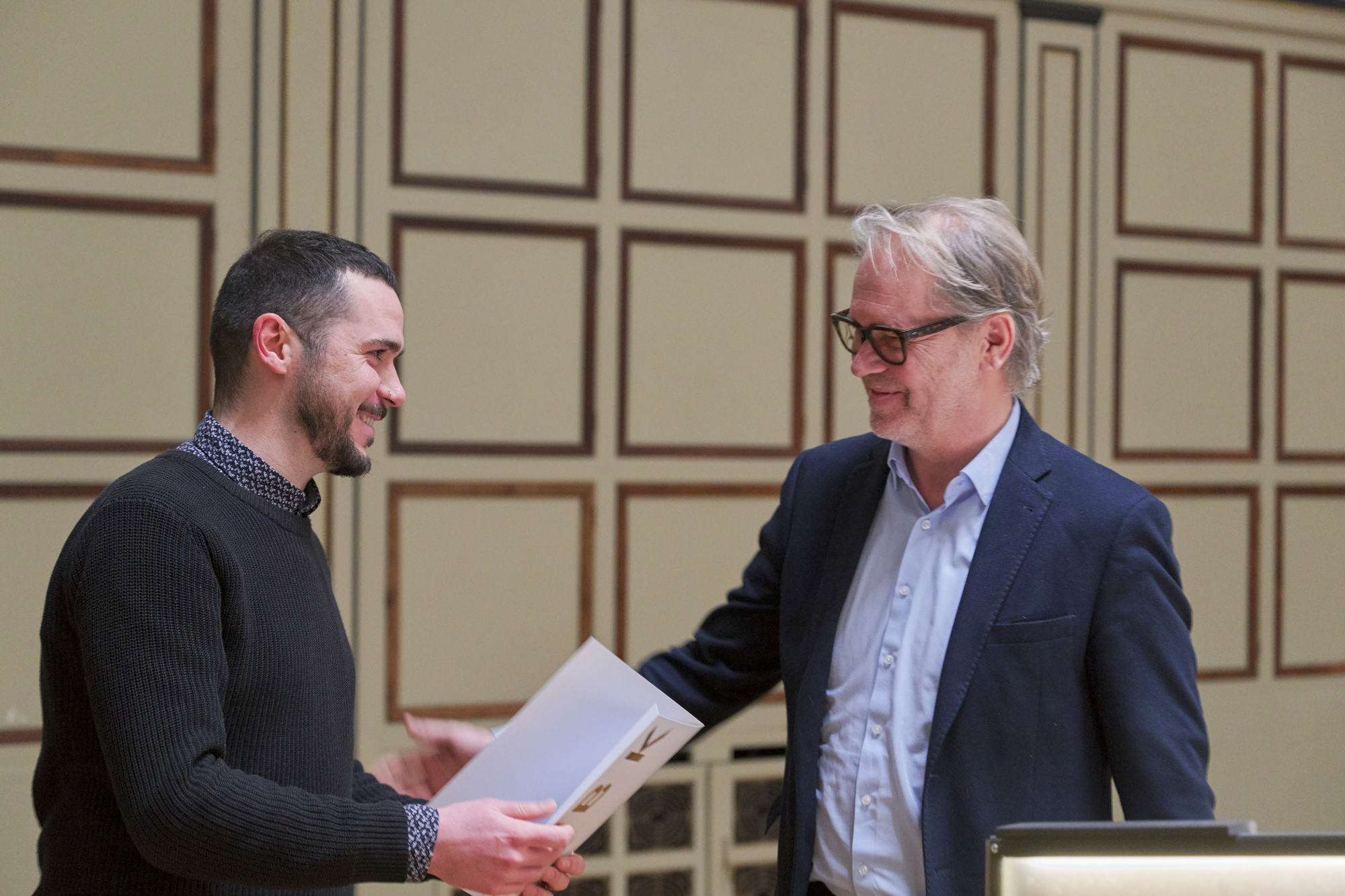
DAAD Prize Winner Santiago Gómez García (Professor Angela Schanelec) was honored for his artistic achievements during his Bachelor’s studies at HFBK Hamburg, which are closely connected to an intensely reflected intercultural practice. His current film project Heiliger Sebastián is a particularly ambitious and highly original work. It combines extensive historical research with a sophisticated cinematic language and explores themes such as faith, power, the formation of community, and the transformation of narratives into institutional memory.
In his work, the filmmaker addresses everyday racism, belonging, linguistic change, and the social realities of migrant communities in Germany. It is grounded in concrete experiences from his own environment and in the desire to document marginalized perspectives on their own terms, rather than leaving them to journalistic or institutional formats. His artistic and social engagement is oriented toward solidarity, visibility, and empowerment within a post-migrant context.
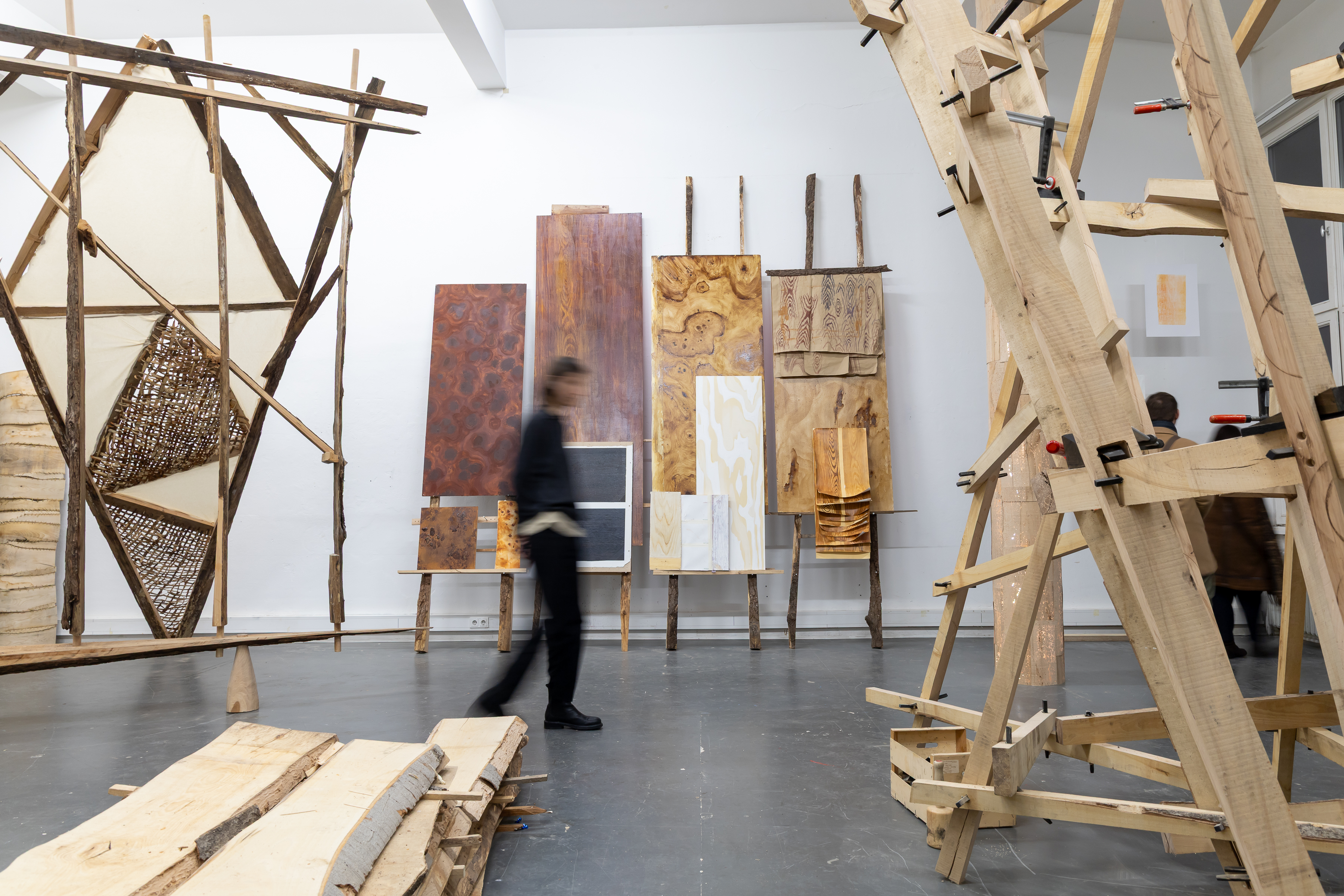
The scholarship of the Stendar-Feuerbaum Foundation was awarded to the collective Sustainable Practices (Professor Anne Femmer). With its project for the Annual Exhibition, the collective—very much in the spirit of the donors Wolfgang Stendar and Renate Stendar-Feuerbaum—addresses the interrelations of material, context, and design while exploring the boundaries between sculpture and space, and between installation and spatial structuring.
Alongside research into materials and construction techniques in wood, their practice focuses on sustainability and engages with the fundamental question of what a sculpture in space can be today. Design is understood as part of ecological systems in which things continuously circulate, transform, and generate new relations that can be made visible in space. In this way, they present design as a practice of immediate “involvement,” in which actors assume responsibility and are inseparably intertwined with objects and processes.
Until Sunday, the current works of around 500 students can be seen as part of the Annual Exhibition. During the three-day event, free guided tours in German, English, and sign language offer numerous opportunities for personal encounters with contemporary artistic production. In addition, the Study Information Day on Saturday provides prospective students with special insight into artistic education at HFBK.