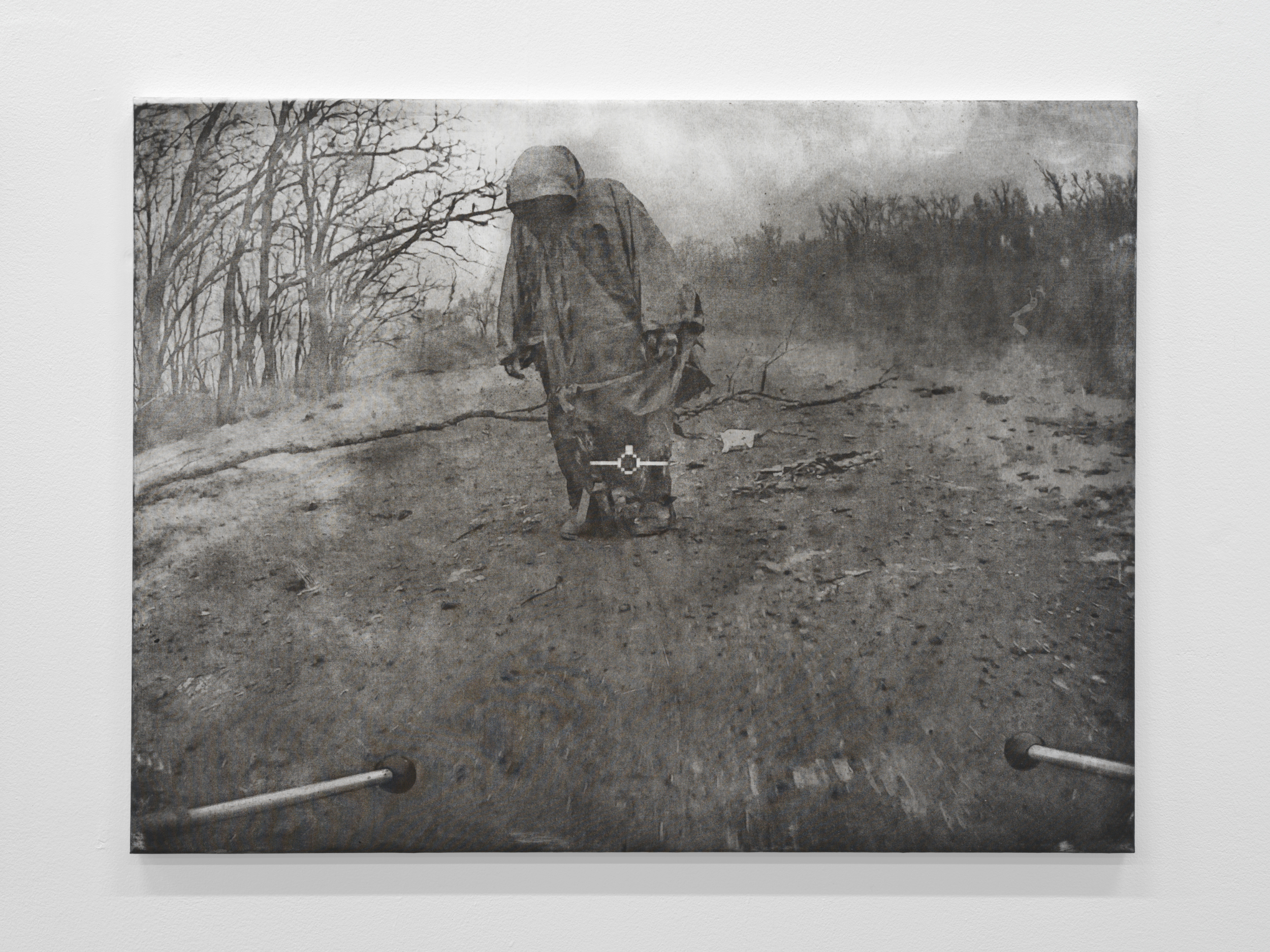
Lesia Hudz, Untitled 8, 2026; photo: Andy Chen
Crossing a Border. Leaving a Gap
Crossing a Border. Leaving a Gap
Lada Nakonechna: Before arriving at the HFBK Hamburg in 2022, you all took different paths. Lesia, you first ended up in Poland and you, Alisa, in Bulgaria, searching for educational or professional opportunities. Each of your emigration stories is unique. Lesia, you first experienced displacement in 2014 when Luhansk was occupied, forcing you to move to Kyiv with your family. This occurred long before the full-scale invasion of Ukraine. Nadiia and Daria, how did it begin for you?
Nadiia Mykhailiuk: We fled as a family in 2022, when the full-scale invasion began (my mother, my two sisters, our dog, and I). We first went to Berlin because we had some contacts in Germany and later ended up near Hamburg. That’s where I found an opportunity to study. In fact, I had never heard of HFBK Hamburg before coming to Hamburg, and I knew very little about contemporary art in general.
Daria Maiier: I was interested in studying in Germany, where many of my friends already studied. After moving with my family to Poland following the full-scale invasion, I looked for ways to continue my studies. I applied through an open call in Hamburg and moved there once I was accepted. I started in Prof. Rajkamal Kahlon’s painting class and later graduated under Simon Denny in the Time-based Media department. It worked out very well for me.
Lesia Hudz: In 2022, many opportunities opened up for Ukrainian artists, and HFBK Hamburg was one of them, offering a straightforward application process. I started in a so-called “Welcome Class Ukraine” and attended theory courses. Later, I became part of Prof. Andreas Slominski’s sculpture class, where I stayed until graduation.
Lada Nakonechna: The link was circulating, so you all applied without knowing the school, and now you’re here.
Daria Maiier: We arrived knowing nothing. HFBK Hamburg helped us navigate paperwork, housing, and bureaucracy, enabling us to settle in and begin our studies.
Alisa Sizykh: I found the system confusing at first because it was so different. Being able to study in English at HFBK Hamburg was crucial, as German-language requirements at other universities would have been a major barrier.
Lada Nakonechna: There are many international students at HFBK Hamburg, some of whom are immigrants. You were admitted to the school under special conditions, which I believe were crucial for a smooth start to your studies. How do you feel about that?
Alisa Sizykh: After enrolling, I realized our case was exceptional. Extraordinary support helped bypass the usual bureaucracy when it was most needed.
Lesia Hudz: Although I was aware of occasional discussions among university students concerning the unequal treatment of different immigrant groups, these conversations faded relatively quickly. For the most part, I experienced compassion and support from the university community throughout these years. After a year in the “Welcome Class Ukraine”, we underwent the official admission procedure to become regular students. Since then, in my experience, we have become deeply embedded in the school’s ecosystem.
Daria Maiier: The arrival of Ukrainians may have highlighted existing inequalities, but should responsibility be put on them? I sometimes feel that discussions on this topic begin with an assumption of blame, and that can shape the direction of the conversation.
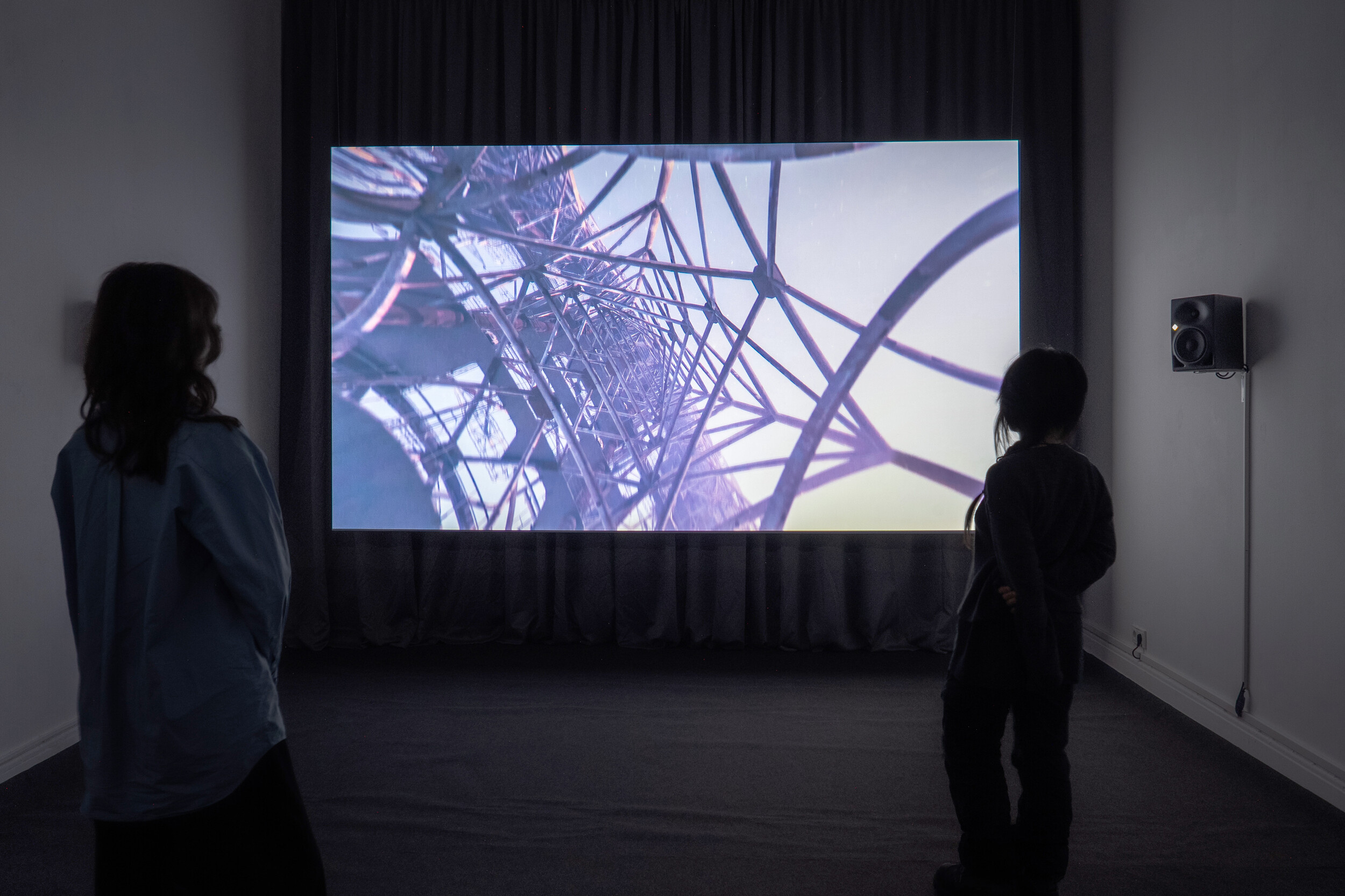
Daria Maiier, DUGA. Ghost Computing, 2026, installation view Graduate Show, HFBK Hamburg; photo: Trent Crawford
Lada Nakonechna: In my opinion, a commitment has also been established: You become artists who represent the school and its legacy. Do you feel integrated, and how have your artistic approaches and chosen themes been received? You arrived with different educational backgrounds and underwent a transformation. Daria, you came from monumental painting, though you had experience with alternative art education in Kyiv, while you, Lesia, studied art history and theory before joining HFBK Hamburg.
Lesia Hudz: It took time to catch up. While my art history studies and intense prior interest in contemporary art provided a sufficient foundation, there was still a significant gap to bridge. Higher education in the field of fine arts in Ukraine remains deeply rooted in the Soviet approach, which is difficult to overcome. As a result, young people interested in contemporary art often have to conduct much of their own research and develop their understanding of the field independently. After these years at HFBK Hamburg, I feel fully integrated into the local art scene. Although my graduation work focuses on the war in Ukraine, the underlying themes of grief, memory, and technological development refer to the broader human condition and address an international audience rather than just a Ukrainian one.
Nadiia Mykhailiuk: Looking back, those four years feel more like seven or eight. I wouldn’t want to repeat that workload, but it was invaluable at the time. I was just beginning to study art and came from a traditional drawing background. With so much theory and so many new conversations about art, it felt like absorbing information at double speed.
Alisa Sizykh: In my theater education, professors tasked students with creating pieces that served a certain function in society and made a clear statement. At HFBK Hamburg, it was the opposite. I learned that many artists prioritize exploring materials rather than serving a specific function.
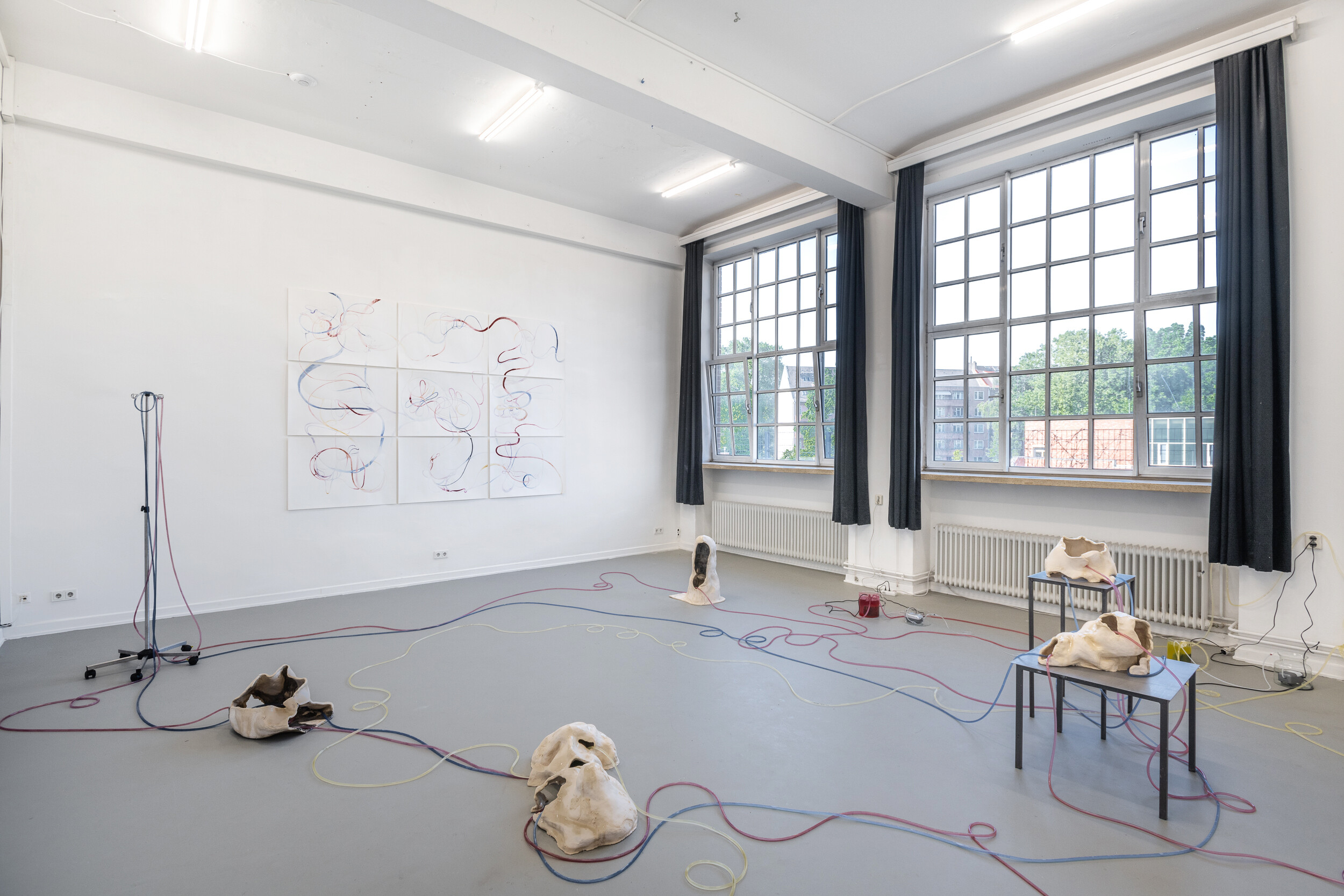
Nadiia Mykhailiuk, Intrinsic Relations, 2026, installation view Graduate Show, HFBK Hamburg; photo: Sergej Hufnagel
Lada Nakonechna: One could say that you learned a kind of “international language of art.” But is it really international? Your work is deeply shaped by your own experiences, addressing history and war. How are these themes received by different audiences? What kinds of conversations or debates do they spark within the school?
Nadiia Mykhailiuk: I graduated with Prof. Anne Duk Hee Jordan, who helped me transform my inner thoughts into a clearer, more concise theory. After discussing the visual aspect of my work with my previous professor, Pia Stadtbäumer, I ended up going completely abstract. Without losing the personal story, it became more indirect.
Lesia Hudz: While preparing for the Graduate Show, my professor asked me if I thought my work would resonate with people in Ukraine. The question stayed with me for quite some time. I began to ask myself if I had the right to work with images of war after leaving Ukraine. However, the positive response, especially from international and Ukrainian audiences, gave me confidence in my work. It reassured me that these images could still speak to those directly affected by war.
Alisa Sizykh: I started communicating with German viewers to provide more context for my work. Politically engaged viewers have a lot of respect for the work, but I see that it takes effort to engage with it, and not everyone is willing to do so. Everyone is free to engage or not. The political context could be perceived as excessive. The discussion mainly revolved around the material or the realization. For example, I received a lot of feedback about the camera perspective. However, I was really interested in the dialogue between the protagonists in my video and in how the work was understood.
Daria Maiier: The strength of HFBK Hamburg lies in its variety of methods offered by each class, all of which are connected to contemporary international practice. This allows students to find the approach that resonates most with them. Our class discussions typically begin with ideas and content. Then, we explore the form that best suits them. In Ukraine, people often connect with my work. The main difference is access to materials and technical resources. Here, I gained the equipment, facilities, and expertise needed for this kind of practice. In Ukraine, media art remains relatively marginal, partly because it requires greater investment and infrastructure. Support structures like David Huss’s Media and Electronics Workshop and Ulf Freyhoff’s Mixed Media Workshop simply do not exist at Ukrainian universities.
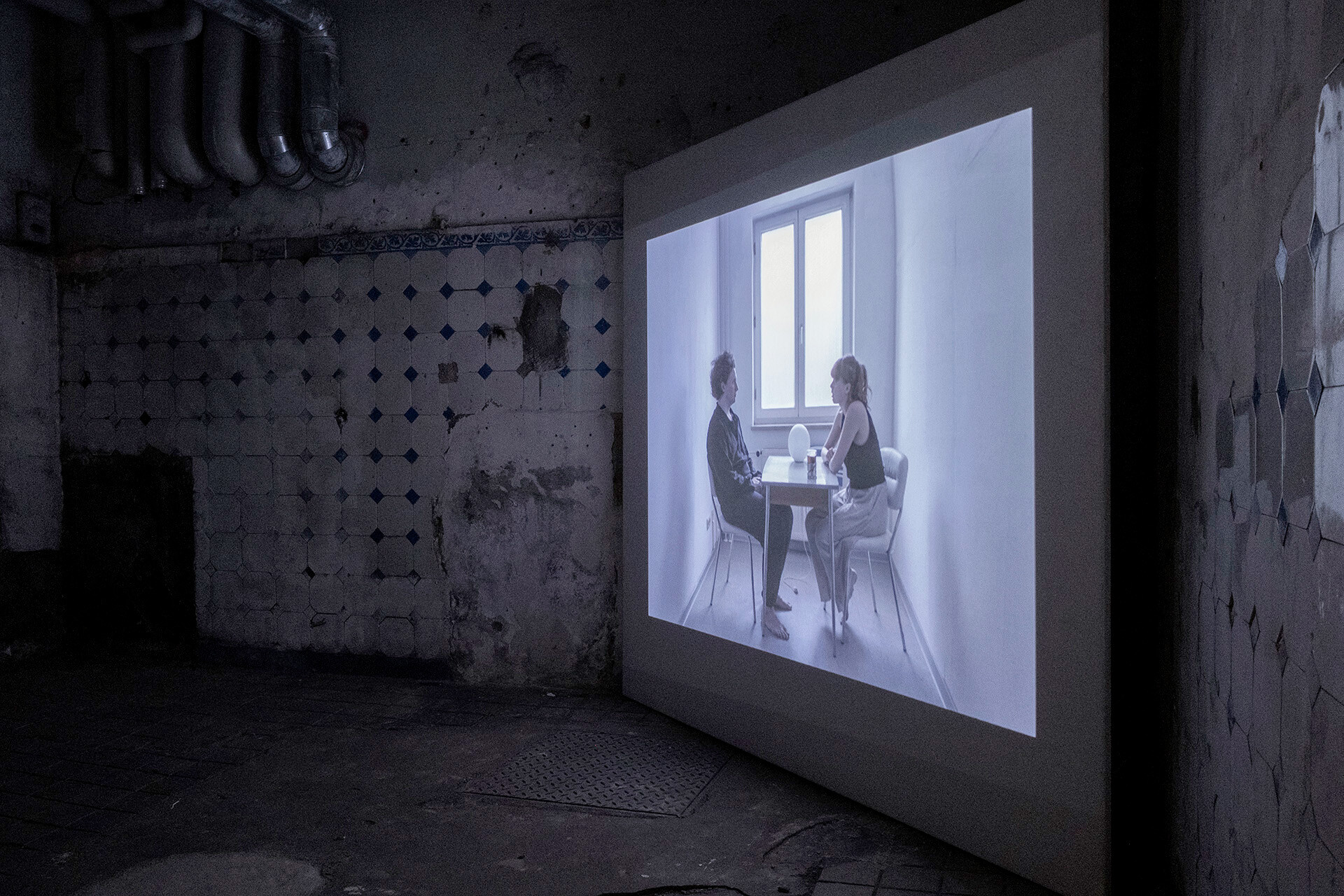
Alisa Sizykh, let’s fuck the end of the world, 2026, installation view Nuclear (off)Spring, Xpon-Art Gallery; photo: Arthur Bondar
Lada Nakonechna: What about moving back? Have your studies and the passage of time created a new gap within the Ukrainian art field? Would you like to maintain or establish new contacts and participate in artistic processes there?
Alisa Sizykh: I would love to be more connected. It’s difficult to follow what’s happening in communities and off-spaces from afar. However, we share the common experience of being at war, and nomadic situations and migrations are nothing new in Ukrainian history.
Daria Maiier: Is this new Ukrainian migration experience being discussed in Ukraine, and is the time right? Our situation is completely different and more privileged. There are far fewer opportunities and funding in Ukraine.
Nadiia Mykhailiuk: The gap between me and my Ukrainian background is getting bigger. I am a big fan of the contemporary Ukrainian art scene, but when I apply to open calls, I feel like I am taking away someone else’s opportunity.
Lesia Hudz: I feel the gap between those who have left and those who have remained in Ukraine growing increasingly wide, even in everyday conversations with close friends and family. Somehow, we are often perceived as those who ran away. And I understand where this perception comes from: The constant stress and exhaustion Ukrainian people experience inevitably contribute to growing tensions and misunderstandings. This raises the question for me of whether our voices are still relevant to Ukrainian art discourse at this moment. This gap is worth exploring, whether now or after the war.