This website uses cookies to display external content and to collect anonymous statistics on usage behavior.
കൊറിയർ സേവനം Kurierdienst Courier Service
HFBK boutique
Arjun Panayal
Particular situations call for specific responses, strategies and solutions. Reflecting on urgent matters and translating them into concrete actions and corresponding aesthetic forms generally forms the starting point of Arjun Panayal’s artistic process. This approach gave rise to Kuvekuva: a cultural emergency-response unit that began as a fictional concept and is now an officially registered company. As part of the exhibition കൊറിയർ സേവനം Kurierdienst Courier Service, the company is temporarily relocating its headquarters from Kerala to Hamburg, establishing a space for specific operational strategies and allegorical exchanges.
The office takes the form of a scenographic installation within the shop-window gallery of the HFBK boutique, offering insights into a contemporary set of questions surrounding mobility, services and exchange. For the time being, the company is investigating the Malayalam orthographic conventions developed by the German missionary and linguist Hermann Gundert (grandfather of Hermann Hesse). Developed in Kerala during the nineteenth century, these conventions were not all officially adopted, yet their influence on the language remains of particular interest today. According to the Hermann Gundert Portal, one of his many orthographic interventions was the introduction of the crescent moon sign (chandrakkala, ്), which modifies the sound of the consonant it accompanies, roughly comparable to the German umlaut. Kuvekuva is fascinated by language as an ideological instrument and as part of a broader colonial project, the origins of which have largely faded from local public memory. To trace these linguistic exchanges, Kuvekuva is currently developing a courier service as one of its many ventures as a conglomerate.
The convenience and seemingly unrestricted mobility of courier services work to the company’s advantage. Inside the office, large packed cartons remain deliberately ambiguous: it is unclear whether they are waiting to be dispatched or have just arrived, and only opening them would reveal what they contain. This ambiguity keeps the office active throughout the exhibition, allowing the company to continue its investigation without attracting the attention of passers-by.
It is no coincidence that Kuvekuva has chosen Hamburg for its temporary office, a city closely connected to global trade and deeply implicated in colonial histories. Within its premises, the company refers to the context of Mönckebergstraße, building a bridge between Kerala and Hamburg.
The temporary Hamburg headquarters of Kuvekuva will officially close on 12 November at 8 pm and enter a state of hibernation from that moment on. Visitors are invited to take one final look inside the premises on that date, from 6 pm onwards.
Design and Thinking Together Partners: Aneeta Abraham, Sreemon C. R.
Photography and Model: Maximilian Glas, Trent Crawford, Mark Morris
With the support of: Giacomo Bonacchi, Giorgio Cesarni, Manjari Goteti, Ulf Freyhoff, Andrew Friedrich, Malte Sommerhoff, Ulrike Wittern
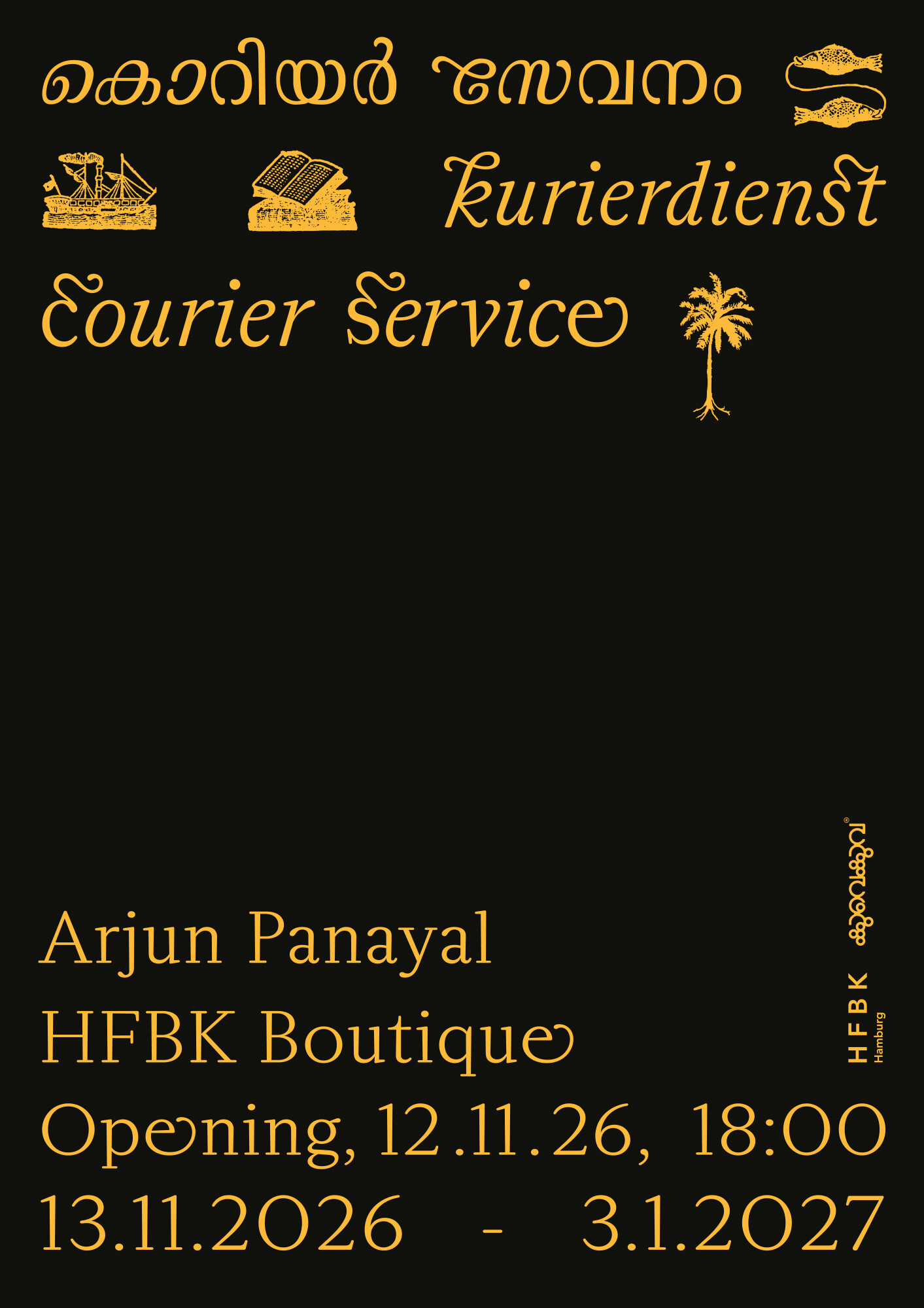
Thursday 12 Nov 2026
Opening
6:00 pm