This website uses cookies to display external content and to collect anonymous statistics on usage behavior.
Symposium
From Environment to Mitwelt
2:00 pm Aula der HFBK Hamburg
Silke van Dyk, Folke Köbberling, Atelier LeBalto, Loraine Leeson, Katja Lonzeck, Sasha Perera, Tilman Walther, Sabine Zahn, Daniela Zyman
A Symposium on Eco-Social World-Shaping
Study Department Design, HFBK Hamburg
Language: German/English
Free admission
Design has a social impact. It shapes and transforms the world in which we live. The social and ecological consequences of this far-reaching practice manifest themselves today as a crisis of democracy and an environmental catastrophe. This dramatic convergence demands that we understand reality not merely as the external environment that surrounds us, but as a network of people, organisms, policies, and objects in which we are embedded.
What would a relational understanding of the “Mitwelt” look like, one in which ecological responsibility is inseparably linked to social justice? How can creative practice gently participate in these co-worldly relationships and take a partisan stance within them?
Together with guests from the fields of art, sociology, design, architecture, performance, activism, and theory, we will discuss possibilities for eco-social practice to explore, endure, and transform our present as a “co-world.”
Participants: Silke van Dyk (Jena), Folke Köbberling (Braunschweig), Atelier LeBalto (Berlin), Loraine Leeson (London), Katja Lonzeck (Hamburg), Sasha Perera (Berlin / London), Tilman Walther (Hamburg), Sabine Zahn (Berlin), Daniela Zyman (Vienna)
Organized by Friedrich von Borries, Johanna Dehio, Anne Femmer, Jesko Fezer, and Anne Duk Hee Jordan.
As part of the symposium, the workshop “Körperliche Raumproduktion” will take place; those interested can register here.
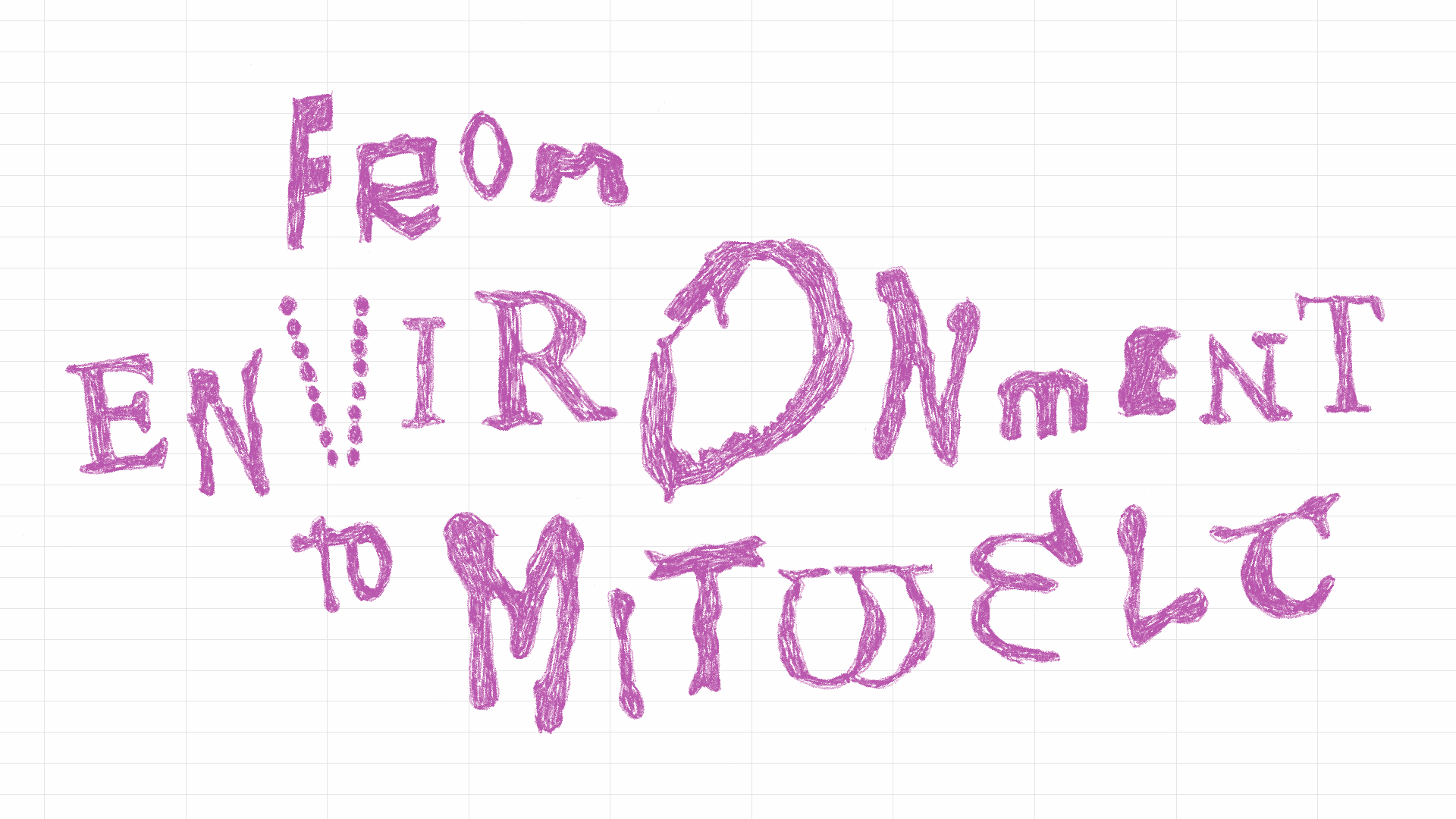
Graphic: Marcel Louis, Class Ingo Offermanns
The program consists of five interrelated sections:
MhVkTwadWELTe (or: Sometimes talks don’t have titles, but aim to explain the WORLD)
Talk by Friedrich von BorriesWorld, Environment, Shared World. Big words. How can one reflect on them if one practices design theory rather than philosophy? What is this discipline’s specific approach? And what does “world” have to do with distinguishing the “global” from the “planetary”? Drawing on his books “Designing the World: A Political Theory of Design” and “Architecture in the Anthropocene: A Speculative Archaeology”—and a new research project with the working title “Holy Shit”—Friedrich von Borries reflects aloud on the limits and possibilities of design, design history, and design theory in the face of global transformation processes.
Making Contact—“Practicing Beginnings”
Workshop and Performative Situation by Johanna Dehio, Sabine Zahn, and Tilman WaltherBuilding on the work done during the foundational year at the HFBK, design is understood as an open, exploratory process that emerges from observation, experimentation, and exchange. The focus is on the conditions of beginning: How do we make contact with one another? How do trust, a shared capacity for action, and responsibility arise? How does an open process become a practice—and how does it position itself within social and ecological contexts? What do we need to learn or unlearn, and how can we act for ourselves rather than reproduce established positions? Together with Sabine Zahn and Tilman Walther, this presentation explores environmental design as a relational practice between the body, space, and the public sphere. The symposium becomes a shared space of experience: thinking is understood not as a purely linguistic process, but as a spatial and physical practice. Participants are active contributors; shared guiding questions connect guests and the audience in the process of thinking.
From the Inside Out
Talk and Debate with Anne Femmer, Folke Köbberling, and Atelier LeBaltoThe past century has made us masters of detached design: The separation of (intellectual-creative) thinking and (physical-material) action made design plannable, delegable, and monetarily “tradable.” This concept of abstraction is now reaching its limits. Not least, New Materialism has challenged the notion of a passive and arbitrarily malleable world and directed our attention to the diverse interconnections between people, materials, and environments. Today, “predictability” confronts an increasingly fragmented, broken, and repair-needy world that can hardly be grasped—let alone shaped—from a distance.
To remain capable of taking action, designers such as Folke Köbberling and atelier le balto repeatedly step beyond the boundaries of their profession and intervene in “realities” through practical, hands-on action. Together, we will discuss the potential of designing from the inside out: from the closest possible proximity to material flows, tools, and practices of transformation.
How to Postpone the End of the World (working title)
Sound Intervention and Discussion with Anne Duk Hee Jordan, Sasha Perera, and Daniela ZymanDrawing on the ideas of Ailton Krenak, this event brings together perspectives from art, curatorial practice, and sound. Krenak is an Indigenous thinker, writer, environmental activist, and an important political voice in Brazil. He belongs to the Krenak people, who live in the Rio Doce region—a river that has been poisoned by one of Brazil’s worst environmental disasters. In his books, he critiques the notion that humans stand outside or above nature. Instead, he views rivers, mountains, animals, and plants as living kin and as part of a shared world. Together with Daniela Zyman and Sasha Perera, we explore how our understanding of the environment can shift toward a “shared world”—a world in which humans, animals, plants, microorganisms, and technologies live in mutual interdependence. Through conversation, sound, and shared reflection, we will explore alternative forms of coexistence, listening as a practice, and how art can open up new relationships with the living world.
The Politics of Community Design
Statements and Discussion with Jesko Fezer, Silke van Dyk, and Loraine LeesonOf course, the environment is always (and perhaps above all) a social context. What connects and divides us are direct and mediated social practices, as well as materialized, subjectivized, and institutionalized social arrangements. The way these are shaped distributes opportunities and exclusions, abundance and scarcity, power and powerlessness. A critical and practical engagement with these powerful interrelationships requires new approaches to the social context of design: actors other than the usual ones must become partners in design processes. But are local communities suitable starting points for creatively addressing social reality? How can we join forces with those who have already begun to take action against these conditions? Together with community art pioneer Loraine Leeson and sociologist Silke van Dyk, we will discuss what an emancipatory relationship between design and local neighborhoods might look like—and what pitfalls neoliberal politics has set in its path.